






The Challenge of Cosmic Billiards
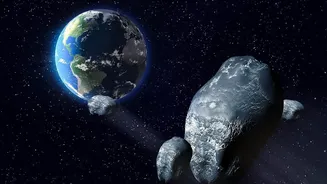
For decades, scientists have grappled with the ultimate 'what if' scenario: a large asteroid on a collision course with Earth. The solution sounds like something from a movie: knock it off course. Methods range from kinetic impactors, like NASA’s successful
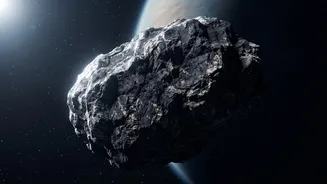
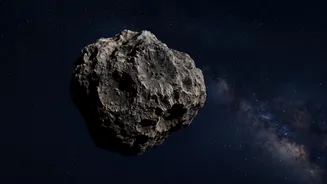
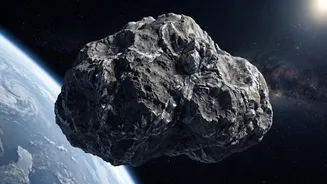
DART mission which physically slammed into an asteroid, to the more dramatic option of a nuclear detonation. The goal of a nuclear option isn't to obliterate the asteroid, which could create a dangerous 'shotgun blast' of smaller fragments. Instead, the idea is to detonate a device at a slight distance. The resulting burst of X-rays would instantly vaporize a thin layer of the asteroid's surface. This vaporized rock shooting away acts like a rocket's exhaust, creating a gentle but firm push to nudge the asteroid onto a new, safer trajectory. The problem, however, is that asteroids are not perfect, smooth spheres. They are lumpy, potato-shaped, and full of ridges and valleys. Previous simulations often simplified them as spheres to make the incredibly complex calculations manageable.
A Faster, Smarter Simulation
This is where the new breakthrough from Sandia National Laboratories, led by physicist Nathan Moore, changes the game. His team developed a new algorithm that is over 1,600 times faster than previous models. This incredible speed allows for something that wasn't feasible before: combining high-fidelity physics with the real, lumpy 3D shapes of actual asteroids. Researchers are no longer forced to choose between realistic shapes and precise calculations. The new model uses detailed 3D imagery of known asteroids—like Bennu and Itokawa—captured by spacecraft on flyby missions. It then simulates a nuclear X-ray burst, allowing scientists to adjust the blast's size, distance, and, most importantly, the angle of impact. The program generates a detailed heat map showing what parts of the surface vaporize, and from that, calculates the resulting push, the change in spin, and how much the surface might break apart.
Location Makes a Five-Fold Difference
The results of these new, more accurate simulations were surprising even to the researchers. 'We expected aim to matter,' Moore stated, 'What surprised us was how much.' For one simulated, irregularly shaped asteroid, hitting it from one angle produced a deflection velocity nearly five times greater than hitting it from another. The push varied from 3.9 millimeters per second down to just 0.8 millimeters per second depending on where the energy was directed. That's the difference between a successful nudge and a near-miss that could still leave Earth in peril. An asteroid's uneven surface, with its slopes and features, dramatically changes how the vaporized material escapes, thus altering the effectiveness of the push. Getting this right is critical for a controlled deflection.
Putting a New Spin on the Problem
It's not just about the push, either. The simulations also revealed that the impact location can drastically change how the asteroid spins. For one of the simulated asteroids, the change in its rotational speed varied by a staggering factor of 17 depending on the angle of the blast. An out-of-control spin could make the asteroid's new path much harder to predict. It also increases the risk of the asteroid breaking apart, which planetary defense experts want to avoid. The ideal scenario is a clean deflection that keeps the asteroid intact, allowing its new course to be tracked reliably. A shattered asteroid becomes a cluster of smaller, unpredictable threats.
Implications for Planetary Defense
This research underscores a crucial point for the future of planetary defense: if we ever need to deflect an incoming threat, we will need to know its shape in great detail. In a real emergency, time would be short, and getting a spacecraft to the asteroid to map its topography would be a critical first step. Moore's new algorithm provides a powerful tool for mission planners to run thousands of scenarios quickly, testing different targeting strategies to find the optimal 'sweet spot' for a deflection. While the model can't yet predict if an entire asteroid will fracture, it represents a significant leap forward in our ability to plan for a potential doomsday scenario. It transforms the challenge from simply 'hitting the asteroid' to a more precise and strategic effort of 'hitting the asteroid just right.'