






The Heart of the Matter
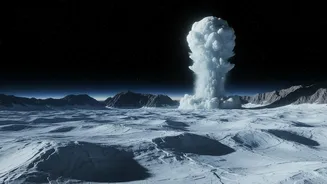
The focus of this surprising discovery is Sputnik Planitia, the vast, western lobe of Pluto's iconic heart-shaped feature, Tombaugh Regio. This enormous basin, larger than the states of Texas and Oklahoma combined, isn't made of water ice but is a massive
glacier of frozen nitrogen. When NASA’s New Horizons spacecraft flew by in 2015, it revealed a stunningly complex surface. Part of this included city-sized cells of nitrogen ice on Sputnik Planitia that are constantly, slowly churning in a process of convection. Between these cells, scientists noticed dark, linear streaks and patches, hinting at a dynamic geology unlike anything previously imagined.
Not Rain, But a Rise from Below
When scientists say 'wet,' they don't mean water. Pluto's frigid surface temperatures make liquid water impossible. The liquid in question is nitrogen. But even that is a puzzle, as Pluto's thin atmosphere prevents nitrogen from falling as rain. The new research, published in the Planetary Science Journal, proposes a fascinating alternative: the liquid nitrogen is seeping up from below the surface. A team led by Alan Stern, the principal investigator for the New Horizons mission, suggests that heat from Pluto's interior could be melting the nitrogen ice at the base of the kilometers-deep glacier. This liquid nitrogen, being less dense than the solid ice above it, would then be forced upward through cracks and fissures.
Clues in the Darkness
The evidence for this subsurface liquid comes from a careful analysis of the dark features spotted by New Horizons. The research team compared these images to satellite photos of glaciers here on Earth, specifically in Greenland. On Earth, similar dark patterns are created when meltwater seeps up from below or rains down, wetting the snow and ice. The resemblance was striking. Computer models developed by researchers at the SETI Institute backed up this visual evidence, showing that conditions beneath Sputnik Planitia could indeed allow for nitrogen ice to melt and travel to the surface. Once on the surface, the models show the liquid nitrogen could flow for a while before refreezing, darkening the ice and creating the exact kind of streaks seen in the images.
A Geologically Active World
This discovery fundamentally changes our understanding of Pluto. For decades, it was viewed as a static, frozen, and geologically dead world. The New Horizons mission began to dismantle that idea, and this latest finding adds another layer of complexity. The surface of Sputnik Planitia is believed to be quite young in geological terms, possibly less than a million years old, because of the constant churning of the ice. This means the processes creating these 'wet' nitrogen flows are not ancient history; they could be recent or even ongoing. “Pluto never stops surprising us,” said Alan Stern of the Southwest Research Institute. This new finding points to Pluto being a dynamic world with active processes that continue to shape its surface.