





Not Fire, Not a Rainbow
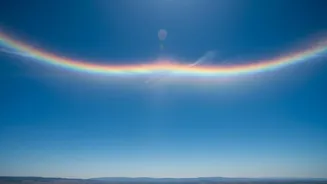
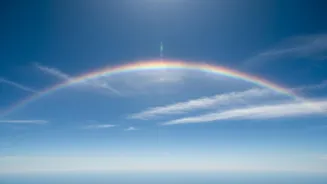
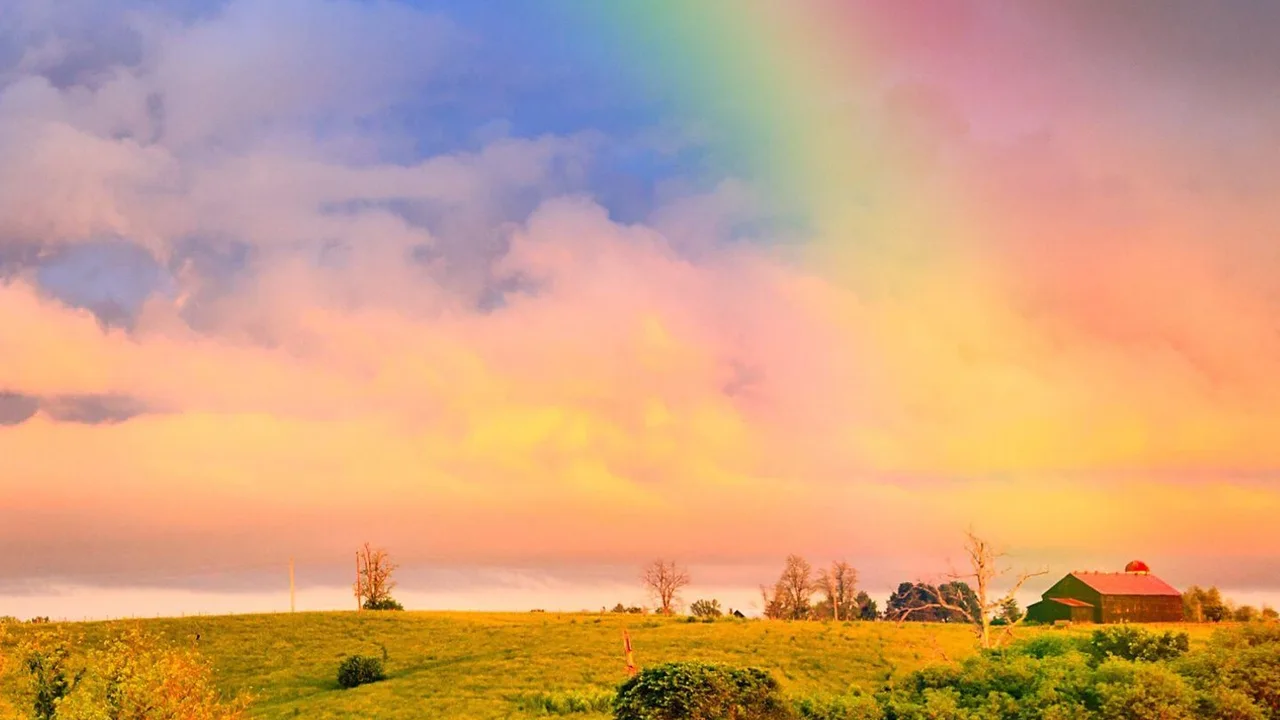
Despite its evocative name, a fire rainbow is neither fire nor a traditional rainbow. The correct scientific term for the phenomenon is a circumhorizon arc. The term 'fire rainbow', coined around 2006, likely comes from its flame-like appearance when
seen in patchy, wispy clouds. Unlike a true rainbow, which is formed by the refraction and reflection of light in water droplets, a circumhorizon arc is an ice halo, created by sunlight interacting with ice crystals in the upper atmosphere. This process creates colors that are often purer and more distinctly separated than those in a typical rainbow.
A Precise Recipe of Sun and Ice
Seeing a circumhorizon arc is rare because it requires a very specific set of conditions to occur. First, the sun must be extremely high in the sky, at an elevation of 58 degrees or more above the horizon. This is why the phenomenon is more common during the summer months and in lower latitudes. For example, Los Angeles has about 670 hours per year where the sun is high enough, while London has only 140. Second, you need high-altitude cirrus clouds. These thin, wispy clouds, found above 18,000 feet, are composed of millions of tiny, plate-shaped hexagonal ice crystals. For the arc to form, these ice crystals must be aligned horizontally, parallel to the ground.
The Science of the Spectacle
When all the conditions are met, the magic happens. Sunlight enters the vertical side of a flat, hexagonal ice crystal and exits through its horizontal bottom face. This 90-degree bending of the light path acts like a prism, splitting the white sunlight into its component colors and projecting them across the sky. Because the countless ice crystals in the cloud are all oriented the same way, they collectively refract the light to form a single, vast, colorful band parallel to the horizon. The arc appears below the sun, often spanning hundreds of miles.
How It Differs From a Regular Rainbow
A key difference from a regular rainbow lies in the position of the sun. To see a rainbow, the sun must be behind you, and the light reflects off falling rain in front of you. For a circumhorizon arc, the sun is high in the sky in front of you, and the arc appears below it. Also, rainbows are formed by liquid water droplets, while fire rainbows are formed by solid ice crystals. It's also important not to confuse a circumhorizon arc with cloud iridescence, which can also create pastel colors in clouds. Iridescence is caused by a different process called diffraction and can appear in many different positions, whereas a circumhorizon arc is always located below the sun.
A Sky Full of Wonders
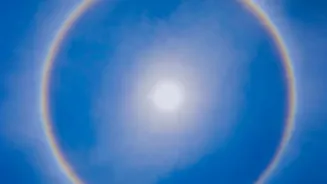
The circumhorizon arc is just one of many fascinating events in the world of atmospheric optics. The same family of ice halos includes phenomena like sundogs (also called parhelia), which are bright spots appearing on either side of the sun, and 22-degree halos, which form a ring directly around the sun or moon. Other optical marvels include crepuscular rays, which are beams of sunlight streaming through gaps in clouds, and glories, which are rainbow-like rings that form around an observer's shadow on a cloud. Each is a result of light interacting with particles like water, ice, or dust in the atmosphere.