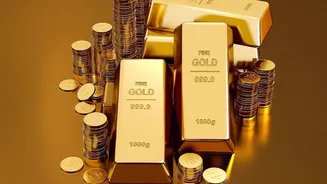








Your Starting Point: Gold in September 2026
To understand the future, we must first establish the present. As of mid-September 2026, the price of 24-carat gold is hovering around ₹1,50,000 per 10 grams. This price can fluctuate based on daily market dynamics, but we'll use this as our baseline.
With an investment of ₹50,000, you would be able to purchase approximately 3.33 grams of 24-carat gold. This amount is the foundation upon which any future growth will be built. It is important to remember that this figure is for the raw gold value; purchases of jewellery or coins would also include making charges and GST, which are not part of the investment's growth potential.
Learning from the Past: Gold's Performance
While no one can predict the future with certainty, history offers valuable clues. Over the last 10 years, gold has shown strong performance in India. From around ₹28,000 per 10 grams in late 2016 to the current levels, the growth has been significant. Various analyses place the Compound Annual Growth Rate (CAGR) for gold in India at approximately 11% to 17% over the last 5-10 years, depending on the exact time frame. This figure, representing the average year-on-year growth, helps us project potential future values. For our scenarios, we will use a range of these historical growth rates to create a balanced perspective.
Scenario 1: A Conservative Outlook (8% Annual Growth)
Let's begin with a conservative scenario, assuming an average annual growth of 8%. This rate is slightly below some recent historical averages but reflects a potential future with stable economic conditions, lower inflation, and higher interest rates, which can sometimes make other investments more attractive than gold. In this scenario, your initial ₹50,000 investment would grow over the next 10 years to approximately ₹1,07,946 by 2036. This outcome represents a more than doubling of your initial capital, showcasing gold’s potential as a steady, long-term wealth builder even in a slower growth environment.
Scenario 2: A Moderate Growth Path (11% Annual Growth)
A moderate growth scenario, based on a CAGR of 11%, aligns closely with the average performance of gold in India over the past decade. This path assumes that the factors currently driving gold prices—such as steady investment demand, central bank buying, and its role as a hedge against inflation—will continue in a similar vein. Should gold prices follow this trajectory, your ₹50,000 investment would be valued at approximately ₹1,42,053 in 2036. This projection underscores gold's robust nature as an asset that has consistently outpaced standard inflation and fixed deposit rates over long periods.
Scenario 3: An Optimistic Bull Run (14% Annual Growth)
In our most optimistic scenario, we'll use a 14% CAGR. This higher rate reflects periods of significant economic uncertainty, high inflation, or major geopolitical instability, all of which tend to drive investors towards the safety of gold. While not guaranteed, such bull runs have occurred in the past. If this were to happen over the next decade, your ₹50,000 investment could potentially reach a value of approximately ₹1,85,327 by 2036. This illustrates gold’s power as a 'crisis commodity'—an asset that not only preserves wealth but can generate substantial returns when other markets are volatile.
Key Factors That Will Influence Gold's Journey
These scenarios are not just numbers; they are driven by real-world forces. The price of gold in India is influenced by a combination of factors. Globally, these include interest rates set by central banks like the US Federal Reserve, the strength of the US dollar, and geopolitical tensions. Domestically, the Rupee-to-Dollar exchange rate plays a crucial role, as gold is imported. Furthermore, demand during wedding and festive seasons, government policies like import duties, and the Reserve Bank of India's own gold purchases all have a significant impact on prices. Understanding these drivers is key to understanding gold's potential.