






A New Eye in the Sky
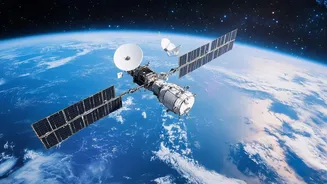
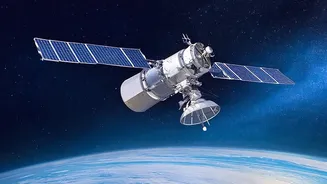
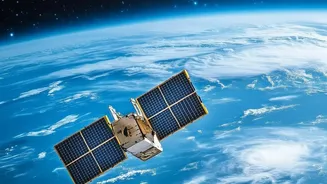
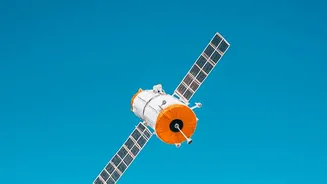
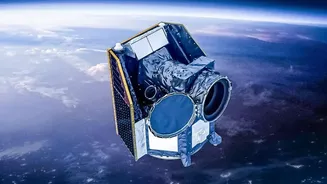
For decades, Earth observation was the exclusive domain of government space agencies and spy thrillers. Now, a convergence of cheaper launch costs and miniaturised technology has democratised the heavens. Companies like Planet Labs, BlackSky, and Maxar
operate hundreds of satellites, creating a near-real-time, high-resolution picture of the planet. Some commercial satellites can be tasked for a fee from home, and resolutions as high as 10-16 cm are becoming available, turning what was once state secret into a commercial product. This private infrastructure has attracted billions in investment and major government contracts, with agencies like the U.S. National Reconnaissance Office now relying heavily on these commercial fleets for imagery. It's a gold rush in low-Earth orbit, with companies racing to build out constellations that will form the backbone of global data and communications infrastructure for decades to come.
The Power of AI-Driven Insight
The sheer volume of data being beamed down—hundreds of terabytes daily—is impossible for humans to analyse alone. This is where artificial intelligence becomes a game-changer. AI and machine learning algorithms sift through this deluge of imagery to find patterns, detect changes, and extract actionable insights automatically. These systems can count cars in parking lots to predict retail earnings, monitor the shadows in oil tanks to forecast energy supply, track deforestation, or identify ships and aircraft. Some companies are now developing satellites that process data directly in orbit using AI, allowing them to transmit compact, meaningful alerts instead of massive raw data files. This fusion of AI and Earth Observation, sometimes called GeoAI, is turning satellite data from a niche tool for experts into a powerful business and logistical superpower.
The Promise: A Smarter, Safer Planet
The applications for good are immense. AI-powered satellite analysis is already being used for environmental monitoring, helping to track wildfires, floods, and methane leaks in near-real-time. In agriculture, it can assess crop health and improve water management. For disaster response, it provides critical information for rescue and recovery efforts. It can help verify corporate claims about sustainability, provide forensic evidence of human rights abuses, and offer transparency on a global scale. By making objective, consistent data more accessible, this technology promises to improve risk assessments for insurers, guide infrastructure development, and hold institutions accountable for their environmental impact.
The Peril: Surveillance, Bias, and Data Monopoly
However, this same technology carries profound risks. The ability to monitor locations with high resolution raises unavoidable privacy concerns. With imagery sharp enough to discern a mailbox from space, individuals can become subjects of surveillance without their knowledge or consent. Furthermore, AI models are only as good as the data they are trained on. Algorithms trained on data from one region may perform poorly or produce biased results when applied elsewhere, potentially reinforcing existing inequalities. There is also the growing danger of fake or misinterpreted satellite imagery being used for digital disinformation, eroding trust in what was once considered objective data. The potential for misuse—by corporations for market manipulation or by governments for suppressing dissent—is significant.
The Governance Black Hole
Technology is advancing far faster than the laws designed to govern it. The core legal framework, the Outer Space Treaty of 1967, was written for a world where space was the domain of a few superpowers, not a traffic jam of commercial satellites. It holds nations responsible for private activities originating from their territory, but there is no global enforcement body. International bodies like the UN's Committee on the Peaceful Uses of Outer Space (COPUOS) and the International Telecommunication Union (ITU) operate on slow-moving consensus and lack enforcement power. This creates a fragmented regulatory landscape, ill-equipped to handle issues like orbital congestion, data privacy in space, and the question of whether a company can beam signals into a country without its consent. The rules are being written on the fly, often by the very companies that dominate the market.