





The Elusive Ghost Particle
Neutrinos are some of the most mysterious and abundant particles in the universe. They are fundamental particles, like electrons, but they have almost no mass and no electric charge. This unique nature allows them to travel across the cosmos almost entirely
unimpeded, passing through planets, stars, and even our own bodies by the trillion every second without us ever noticing. While this makes them fascinating cosmic messengers, it also makes them incredibly difficult to detect and study. Scientists have built colossal detectors, often deep underground or under Antarctic ice, to catch the rare instance when a neutrino interacts with matter. The 'neutrino puzzle' refers to several questions physicists are trying to answer: Where do the most energetic neutrinos come from? What are their exact masses? How do they change from one 'flavour' to another?.
A Signal from the Shadows
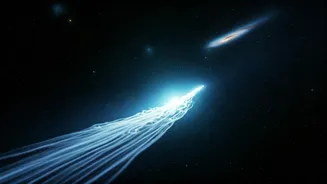
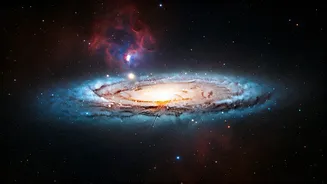
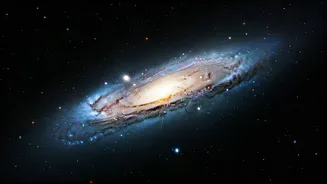
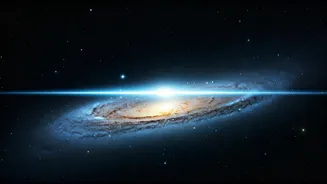
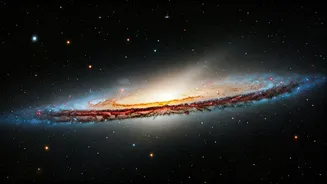
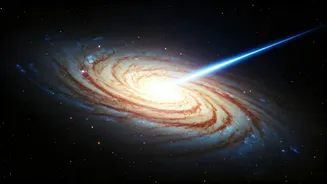
The latest piece of the puzzle began in 2021, when the IceCube Neutrino Observatory—a massive detector buried in the Antarctic ice—recorded a single, extremely high-energy neutrino. The event, named IC 210922A, sent astronomers scrambling to find its source. They scanned the patch of sky it came from, but found none of the usual suspects, like an exploding star or a galaxy with a violently active supermassive black hole at its centre. An international team then used other telescopes, like the Atacama Large Millimeter/submillimeter Array (ALMA), to look for sources hidden by vast clouds of cosmic dust. They found their culprit: a distant, intensely bright galaxy nicknamed the "Shadow Blaster" because it was so heavily veiled by dust.
A Different Kind of Engine
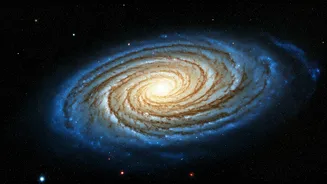
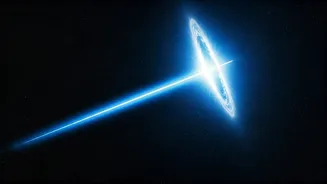
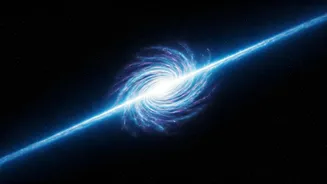
Until now, the prime suspects for creating such high-energy neutrinos were active galaxies powered by supermassive black holes. These cosmic monsters are known to launch jets of particles at near-light speeds. But when scientists studied the Shadow Blaster, they found no evidence of a hyperactive black hole. Instead, they found that the galaxy was undergoing an extraordinary burst of star formation within a very dense, compact core. The findings suggest that this extreme star-forming environment—a 'starburst' galaxy—can act as a natural particle accelerator, creating the conditions necessary to produce high-energy neutrinos. This is a completely new type of source for these particles.
Why This Changes Everything
This discovery is significant because it helps explain a long-standing discrepancy. While detectors like IceCube have observed a steady stream of high-energy neutrinos coming from all over the sky, the few previously identified sources couldn't account for the total number seen. The existence of starburst galaxies as neutrino factories offers a new category of objects that could be responsible. Researchers estimate that galaxies like the Shadow Blaster could account for a substantial portion, perhaps up to 20 percent, of this unexplained cosmic neutrino background. It suggests that the universe has more than one way to produce its most energetic ghost particles, broadening our understanding of the most extreme processes in the cosmos.
India’s Quest for the Ghost Particle
This global search for cosmic secrets has a strong Indian connection. India is in the process of building its own world-class facility, the India-based Neutrino Observatory (INO), in Tamil Nadu. The project's main goal is to build a massive magnetised iron calorimeter detector, located deep underground, specifically to study atmospheric neutrinos—those created when cosmic rays hit Earth's atmosphere. By making precise measurements of how these neutrinos oscillate, or change flavour, INO aims to help solve key parts of the neutrino puzzle, such as determining the ordering of neutrino masses. The development of the INO, including operational prototypes, places India among the leading nations in the quest to understand this fundamental particle.