


A Powerful Alliance in Space
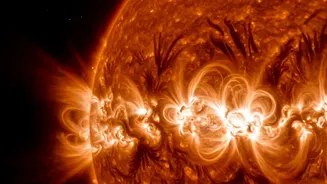
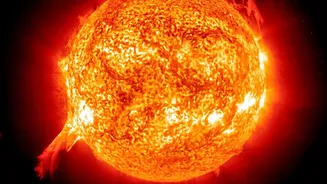
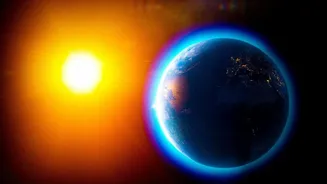
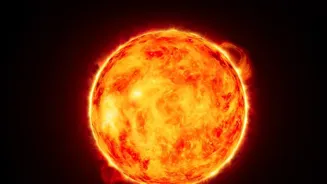
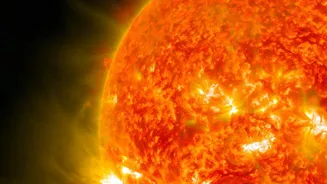
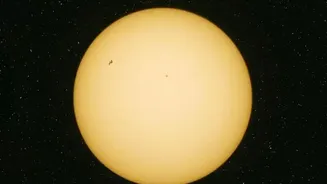
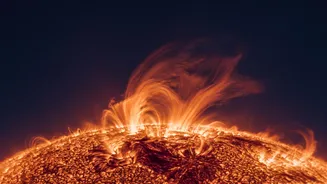
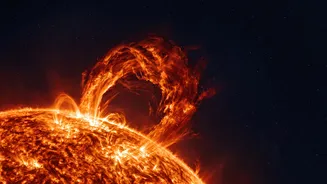
The Sun’s outer atmosphere, the corona, is a place of mystery and immense power. It is where solar flares and coronal mass ejections (CMEs) are born—colossal explosions of plasma and magnetic fields that can travel across space and impact Earth. Understanding
the energy of these eruptions is critical for predicting space weather, which can disrupt our satellites, power grids, and communication networks. For the first time, scientists are combining data from two distinct but complementary missions to get a complete picture. Researchers led by the Indian Institute of Astrophysics (IIA) in Bengaluru have analysed joint observations, marking a new chapter in Indo-European space cooperation and solar physics.
India’s Watchful Eye: Aditya-L1
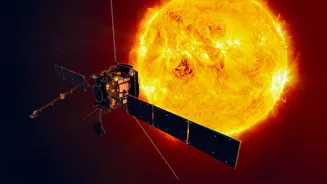
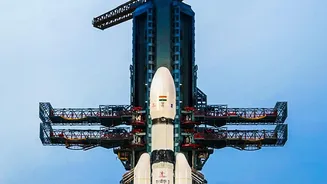
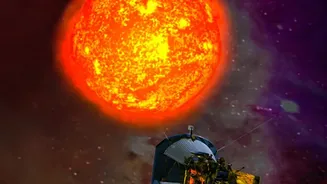
Launched by ISRO in September 2023, Aditya-L1 is India’s first dedicated solar observatory. Stationed at Lagrange Point 1 (L1), about 1.5 million kilometres from Earth, it has an uninterrupted view of the Sun. Its key instrument for this research is the Visible Emission Line Coronagraph (VELC). Developed by the IIA, VELC is a sophisticated instrument that performs spectroscopy, essentially breaking down the light from the corona. This allows scientists to measure crucial properties of the super-hot plasma, including its density and thermal energy (its heat). Aditya-L1 gives scientists the 'what' and 'how hot' of the material being ejected.
Europe's Artificial Eclipse: Proba-3
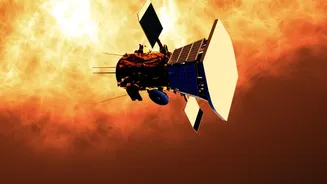
The European Space Agency's (ESA) Proba-3, launched by an ISRO PSLV rocket in December 2024, is a mission unlike any other. It is the world's first precision formation-flying mission. It consists of two separate spacecraft flying in a perfectly synchronized tandem about 150 metres apart. One satellite, the 'Occulter', blocks the bright face of the Sun, casting a precise shadow over the second satellite, the 'Coronagraph'. This creates a near-perfect artificial eclipse, allowing its ASPIICS instrument to see the extremely faint inner corona with unprecedented clarity—a region notoriously difficult to observe. Proba-3 provides the 'where' and 'how fast' of the eruption, capturing sharp images of its shape, speed, and mass.
Two Views Are Better Than One
The real breakthrough comes from combining these two unique perspectives. While Proba-3 provides crisp images of the CME's structure and movement, Aditya-L1's VELC analyses the physical state of the plasma within that structure. A recent study published in the journal 'Astronomy & Astrophysics' analysed two CMEs that were observed by both missions in September 2025. One was a fast-moving eruption travelling at about 645 km/s, while the other was much slower at 145 km/s. By combining the imaging data from ASPIICS with the spectroscopic data from VELC, scientists could independently calculate and cross-check the mass, density, and different forms of energy—kinetic, thermal, and magnetic—of the eruptions as they evolved.
Unlocking the Secrets of Solar Energy
The joint analysis revealed fascinating differences in how the two eruptions distributed their energy. In the faster CME, the kinetic energy (energy of motion) was dominant, with thermal energy making up only about 1% of the total. However, in the slower eruption, the thermal energy grew to become comparable to the kinetic energy, and its density dropped more sharply, suggesting it expanded more powerfully in its initial phase. These details, previously impossible to measure so close to the Sun's surface, provide crucial new constraints for the models that predict how CMEs will behave as they travel toward Earth. The agreement between the independent measurements from both spacecraft has given scientists high confidence in the results, validating the power of this collaborative approach.