







The Cosmic Heist and an Endless Chase
The primary reason eclipses are considered impure in Hinduism lies in the ancient story of the Samudra Manthan, or the churning of the cosmic ocean. According to mythology, the gods (Devas) and demons (Asuras) worked together to churn the ocean to obtain
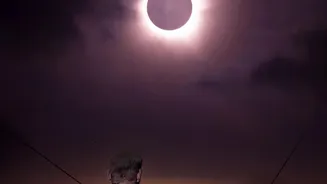
Amrita, the nectar of immortality. When the nectar emerged, Lord Vishnu took the form of a beautiful maiden, Mohini, to trick the demons and ensure only the gods received it. However, an asura named Svarbhanu disguised himself as a god and managed to drink a drop. The Sun (Surya) and Moon (Chandra) gods spotted the deception and alerted Vishnu, who immediately severed the demon's head with his Sudarshana Chakra. Because the nectar had made him immortal, Svarbhanu's head and body survived as two separate entities: Rahu (the head) and Ketu (the body). Filled with vengeance against the Sun and Moon for exposing him, Rahu is said to periodically swallow them, causing an eclipse. Since he has no body, the Sun or Moon eventually re-emerges, but the act itself is seen as a demonic attack on the celestial sources of light and life.
A Period of Ritual Impurity
This mythological event frames the eclipse period, or 'Grahan', as a time of struggle when negative forces are ascendant. This gives rise to the concept of 'Sutak', a period of ritual impurity that begins hours before the eclipse and ends only after it is over. For a solar eclipse, the Sutak period starts 12 hours prior, while for a lunar eclipse, it begins 9 hours before. During this window, the atmosphere is believed to be contaminated with negative energies. This belief leads to a host of prohibitions. Cooking and eating are avoided, as food is thought to become impure and harmful. Many households discard any food prepared before the Sutak period and cook fresh meals only after the eclipse has passed and the home has been cleansed. To protect stored grains and water, leaves of Tulsi (holy basil) are often placed in them, as the plant is believed to have purifying properties.
Washing Away the Shadows
Given the perceived impurity, purification rituals are central to eclipse traditions. The most significant of these is bathing. It is customary to take a bath both at the start and, more importantly, at the end of an eclipse. This is not just a physical cleansing but a symbolic washing away of the inauspicious energies associated with the Grahan. Many devout Hindus travel to holy rivers like the Ganga, believing a dip in its sacred waters during this time is especially meritorious and cleansing. Beyond bathing, other purification practices include closing temples, chanting protective mantras like the Mahamrityunjaya Mantra, and making donations (daan) after the eclipse, which is believed to mitigate any negative effects. These acts are performed to restore spiritual harmony and balance after the cosmic disruption.
A Global Phenomenon
While the story of Rahu and Ketu is specific to Indian culture, the idea of eclipses as bad omens is a near-universal theme across ancient civilisations. In ancient China, it was believed a celestial dragon was eating the sun, and people would bang drums to scare it away. For the ancient Greeks, an eclipse signified the anger of the gods and the abandonment of Earth. Vietnamese folklore tells of a giant frog swallowing the sun. The common thread in these stories is the interpretation of a natural event as a threatening disruption of the cosmic order. The response, whether it was making loud noises or performing rituals, was an attempt to restore balance and appease powerful, unseen forces.
Science, Belief, and Coexistence
Today, science provides a clear and predictable explanation for eclipses: they are simply alignments of the Earth, Moon, and Sun. We know exactly when they will occur and that they pose no inherent danger beyond the need to protect our eyes when viewing a solar eclipse. Yet, the ancient traditions persist. For many, these practices are not about rejecting scientific fact but about upholding a cultural and spiritual worldview. The rituals associated with eclipses serve as a powerful link to heritage, a moment for communal and personal spiritual reflection, and a way of acknowledging that some events can carry both astronomical and symbolic weight. They represent a deeply ingrained system of meaning, transforming a celestial shadow play into an opportunity for spiritual renewal.