





The Enduring Mystery of Venus's Clouds
For decades, Venus has been a symbol of a paradise lost. Similar in size and mass to Earth, it took a dramatically different evolutionary path, ending up with a surface hot enough to melt lead and an atmosphere thick with carbon dioxide and clouds of concentrated
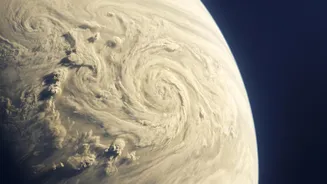
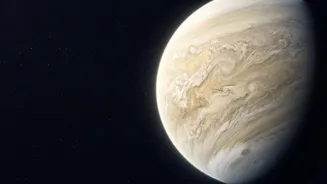
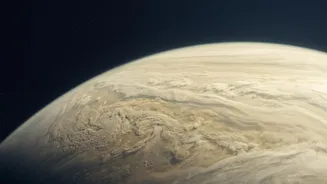
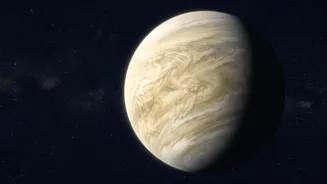
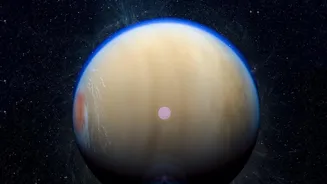
sulfuric acid. This hostile environment has long been considered one of the least likely places to find the building blocks of life in our solar system. The clouds themselves present a long-standing puzzle. While they appear a placid, pale yellow in visible light, ultraviolet images reveal dark, streaky patches that swallow sunlight. Scientists have known about this “unknown absorber” for about a century, but its chemical identity has remained a complete mystery, driving much of the scientific curiosity about our neighbouring planet.
A Surprising Discovery in the Acid
The long-held assumption was that the highly corrosive sulfuric acid, with concentrations reaching 98%, would instantly destroy any complex organic molecules. However, a recent study from researchers at MIT has turned this idea on its head. Their laboratory experiments showed that peptides — short chains of amino acids which are fundamental building blocks of proteins — do not just survive in concentrated sulfuric acid, but can remain stable for weeks. More astonishingly, they spontaneously fold into well-defined, three-dimensional structures. A molecule’s shape dictates its function, so this finding suggests that these essential molecules could, in theory, perform complex biological functions even within the harsh acid droplets of Venus's clouds. This doesn't prove life exists there, but it cracks open a door that was long thought to be sealed shut.
Chasing the Unknown Absorber
While some research explores the potential for life's ingredients, other new studies are homing in on the chemical nature of the clouds themselves. The mysterious dark patches absorb more than half of all the solar energy that reaches Venus's cloud tops, playing a huge role in powering the planet’s super-rotating, high-speed winds. One recent analysis calculated that whatever is causing this absorption must be incredibly efficient or exist in very high concentrations. Some older theories pointed to a potential biological source, but newer research provides compelling chemical explanations. One study from Cambridge University suggests that a combination of two iron-bearing sulfate minerals, rhomboclase and acid ferric sulfate, could explain the UV absorption pattern when suspended in sulfuric acid. This inorganic explanation provides a strong alternative to more exotic theories, though the mystery is far from solved.
Implications for Future Missions
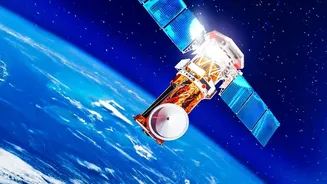
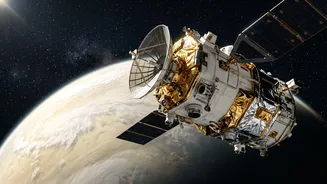
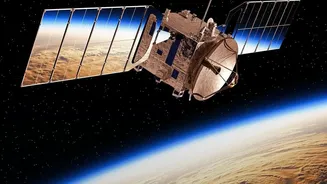
These new findings have profound implications for how we search for life and for upcoming missions to our sister planet. By showing that complex chemistry is possible in non-water-based environments, it forces scientists to broaden their definition of a potentially habitable world. Laboratory experiments can only take us so far; the real answers lie in direct observation and sampling of the Venusian atmosphere. This is where future missions become critical. India's own planned Venus orbiter, Shukrayaan-1, is designed to study the planet’s atmosphere in detail. With a suite of instruments, it aims to investigate Venus’s geological activity, map its surface, and analyze the composition of its enigmatic clouds. Along with planned missions from NASA and the European Space Agency, Shukrayaan-1 is part of a new wave of exploration that will put these fascinating new theories to the ultimate test.