




The Classic Giant-Impact Story
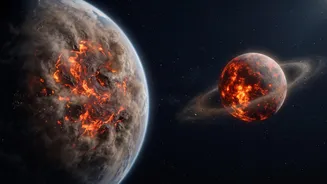
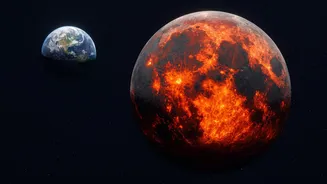
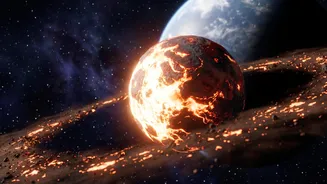
For decades, the leading theory for the Moon's origin has been the Giant-Impact Hypothesis. It posits that about 4.5 billion years ago, the Solar System was a chaotic place. A young Earth was struck by a Mars-sized protoplanet named Theia. This colossal
collision would have been energetic enough to melt and vaporize enormous amounts of rock, flinging a massive ring of debris into orbit. Over a period of months or years, this material is thought to have gradually clumped together, or accreted, to form the Moon we see today. This elegant theory explains many things, including the Moon's size, its orbit, and why it has a relatively small iron core compared to Earth.
An Assumption of Liquid Worlds
A crucial, and logical, assumption has underpinned most simulations of this event: that the impact was so violent, the colliding bodies behaved like simple fluids. The thinking was that the sheer energy would have melted both Theia and the proto-Earth, making their material strength irrelevant. Models therefore treated them as two colliding drops of liquid, governed primarily by gravity and pressure. This approach successfully recreated many features of the Earth-Moon system. However, it struggled to cleanly resolve a major puzzle known as the 'isotope crisis'. Rocks from the Moon brought back by Apollo astronauts showed that the Moon and Earth have a nearly identical isotopic signature, like geological twins. If the Moon formed mostly from the debris of Theia, as early models suggested, it should have a different isotopic fingerprint.
Introducing Material Strength
Recent research has thrown a fascinating wrench into the works by challenging the 'fluid worlds' assumption. New simulations from the Southwest Research Institute and the University of Arizona account for the material strength of the colliding bodies for the first time. Researchers realised that while incredibly hot, the interiors of the proto-Earth and Theia might still have been mostly solid, not entirely molten. They found that the pre-impact temperature of the planets makes a huge difference. A colder, and therefore stronger, Theia doesn't just splash into a debris disk. Instead, the collision can break it apart in a way that places a large, mostly intact chunk of material directly into orbit within hours, not months or years.
A Faster Formation, A New Timeline
This new perspective fundamentally changes how we think about the Moon's birth. Instead of slowly coalescing from a ring of rubble, the Moon could have been born almost instantly. Simulations factoring in material strength showed that a recognisable Moon could emerge in as little as five hours after the impact. This rapid-formation model offers a more elegant solution to some of the Moon's mysteries. For example, a faster formation process could help explain the similar isotopic compositions, as it may have allowed for more thorough mixing of material from both Earth and Theia in the immediate, chaotic aftermath. Furthermore, the temperature and strength of Theia create a link between how the Moon formed and when it formed. A hotter, weaker impactor aligns with an earlier collision, while a colder, stronger one suggests the impact happened later in the Solar System's history.