






A Frozen Time Capsule
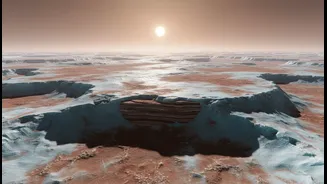
The focus of this new excitement is the northern polar cap of Mars, a vast expanse of water ice and dust known as Planum Boreum. For years, scientists have viewed these polar layered deposits as a potential record of the planet's climate history, similar
to how ice cores on Earth reveal our own planet's past. Each layer of ice and dust was laid down over thousands of years, capturing a snapshot of the environmental conditions at the time. Recent studies have reinforced the idea that this region is more than just a climate record; it could be a geological freezer, perfectly preserving clues about ancient Martian environments and, possibly, the life that may have existed within them. This makes the northern shelf a high-priority target in the ongoing quest to understand if Mars was ever habitable.
The Science of Ice Preservation
Why is ice considered a better preserver of ancient life than rock or soil? Recent laboratory experiments provide a compelling answer. A study led by researchers from NASA and Penn State recreated the harsh conditions of Mars to see how organic molecules, the building blocks of life, would fare. They found that amino acids trapped in pure water ice could survive for more than 50 million years, even when exposed to relentless cosmic radiation. In contrast, when mixed with simulated Martian soil, the same organic material degraded ten times faster. The theory is that in pure ice, harmful radiation particles are locked in place and cannot easily reach and destroy the delicate organic compounds. This suggests that drilling into clean, buried ice could be a far more effective strategy for finding biosignatures than sifting through the planet's reddish dirt.
Reading the Layers of History
The northern ice cap is a massive structure, about 1,000 kilometers in diameter and up to two kilometers thick in places. Radar data from NASA's Mars Reconnaissance Orbiter has allowed scientists to peer deep beneath the surface, revealing thousands of individual layers of ice and dust. These layers document cycles of climate change on Mars, driven by long-term variations in the planet's tilt and orbit. Scientists believe these layers hold a detailed record stretching back millions of years. By studying the thickness and composition of each layer, researchers can reconstruct when Mars experienced ice ages and warmer periods. Some of these warmer periods in the distant past may have created environments capable of supporting liquid water and, by extension, life.
A Different Kind of Ocean
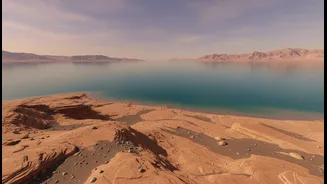
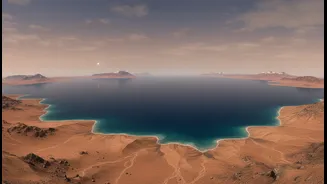
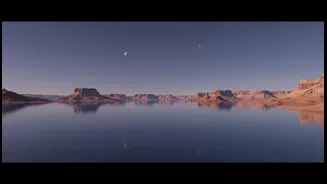
The idea of a watery past in the northern hemisphere is not new. The entire northern third of Mars is a vast, smooth lowland, leading many to hypothesize it once held a massive ocean. Recent analysis of elevation maps has identified features that look remarkably like a continental shelf on Earth, suggesting a large, stable body of water was present for a very long time. While that liquid ocean is long gone, its legacy may be locked away in the polar ice that now covers much of that same region. The water that once flowed in rivers and filled a potential northern ocean may now be part of the immense ice deposits at the pole, trapping chemical and perhaps biological evidence of that ancient, wetter world.
A Roadmap for Future Missions
These findings have profound implications for the future of Mars exploration. For decades, rovers have focused on crater floors and ancient riverbeds, searching for signs of past water in sedimentary rocks. While this has yielded incredible discoveries, the new research makes a strong case for shifting focus to the poles. Future robotic missions, and eventually human explorers, could be designed to drill deep into the northern ice cap. An ice core retrieved from Planum Boreum could be the Martian equivalent of the Rosetta Stone, providing a key to deciphering the planet’s history and answering the ultimate question: did life ever arise on Mars, and if so, what happened to it? The evidence, researchers now suggest, may be waiting just beneath the ice.