



Science fiction paints a terrifying picture of black holes: insatiable monsters roaming the cosmos, sucking in everything in their path. But the reality is less about monstrous appetite and more about the fundamental laws of physics.
The Cosmic Vacuum Cleaner Myth
The popular image
of a black hole is that of a cosmic vacuum cleaner, aggressively pulling matter from its surroundings with a mysterious, unstoppable force. This idea suggests that if a black hole were to appear nearby, it would inevitably 'suck in' entire star systems. This misconception stems from a misunderstanding of how gravity works. A vacuum cleaner operates by creating a pressure difference, actively drawing in air and debris. Gravity doesn't work that way; there is no suction involved. Instead, gravity is an attractive force between any two objects with mass, and its strength depends on how massive the objects are and the distance between them. Black holes, despite their extreme nature, are bound by these same universal rules.
Just Another Massive Object
From a safe distance, a black hole's gravitational pull is no different from that of a star with the same mass. It's a classic thought experiment in astrophysics: if our Sun were instantly replaced with a black hole of the exact same mass, Earth and the other planets would continue in their orbits unchanged. We would lose the Sun's light and heat, plunging our world into a deep freeze, but we would not be 'sucked in'. The Earth would continue its yearly journey around this new, dark centre of our solar system. This is because at that distance, the gravitational force exerted by the black hole is identical to the force the Sun exerted. The danger of a black hole isn't its existence, but its proximity.
The Point of No Return
The truly unique feature of a black hole is its event horizon. This isn't a physical surface you could touch, but rather an invisible boundary in spacetime. It marks the 'point of no return'. Once an object crosses the event horizon, the curvature of spacetime becomes so extreme that all paths lead inward toward the singularity at the centre; escape is impossible, even for light. However, this extreme effect is confined to the immediate vicinity of the black hole. An object must get very close to cross this boundary. For a black hole the mass of our sun, its event horizon would only be about 3 kilometres in radius. For a supermassive black hole like the one at our galaxy's centre, the radius is much larger—about 12 million kilometres—but still minuscule on a cosmic scale.
You Can Safely Orbit a Black Hole
Just like planets can orbit a star, it is entirely possible to have a stable orbit around a black hole. As long as a spacecraft, planet, or star remains at a safe distance outside the most extreme gravitational effects, it can continue to circle the black hole indefinitely. The key is maintaining sufficient velocity to counteract the gravitational pull, the same principle that keeps the Moon in orbit around Earth. However, there is a limit called the Innermost Stable Circular Orbit (ISCO), the closest distance at which a stable orbit is possible without constant propulsion. Getting any closer than the ISCO means an object's orbit will become unstable, and it will begin to spiral inward.
How Things Actually Fall In
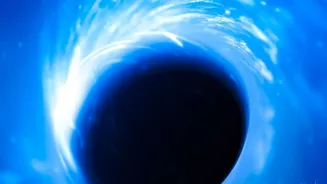
So, if black holes don't suck, how does anything end up inside them? Matter doesn't fall in a straight line as if pulled by a vacuum. Instead, gas and dust that drift too close are captured by the black hole's gravity and form a swirling, hot structure called an accretion disk. Within this disk, particles rub against each other, creating immense friction. This friction causes the material to heat up to millions of degrees, radiating brightly in X-rays, and to lose energy and angular momentum. As it loses momentum, the matter spirals inwards, eventually crossing the event horizon. It's a gradual, orbital process of falling, not an instantaneous suction.