





What is Happening to the Glaciers?
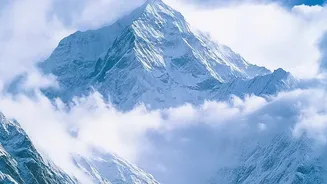
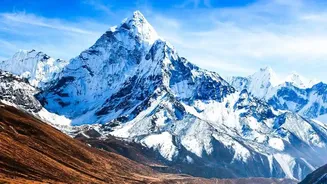
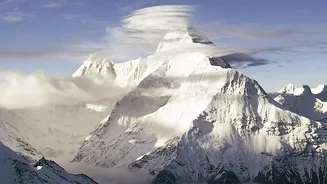
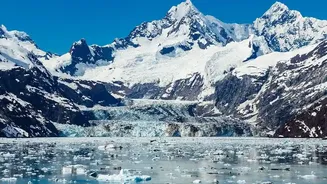
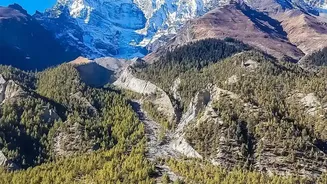
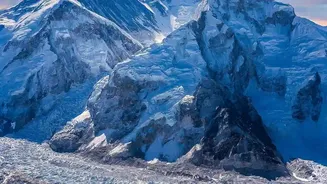
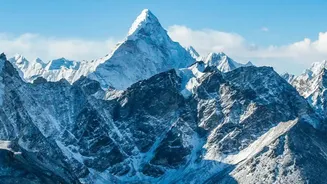
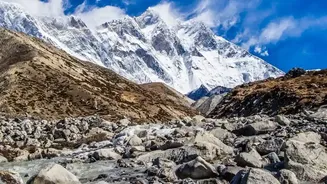
The Himalayas are warming at a rate significantly faster than the global average. This accelerated warming is causing glaciers—vast rivers of ice—to shrink and retreat at an unprecedented pace. Since 2000, the rate of ice loss in the Hindu Kush Himalaya region
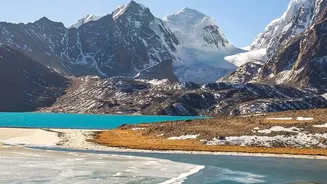
has roughly doubled. This isn't just a simple melting process. As glaciers recede, they leave behind massive lakes, often held in place by unstable natural dams made of loose rock and debris (moraine). These lakes are growing in both number and size, creating precarious situations high in the mountains. Furthermore, the permafrost that acts as a glue holding mountain slopes together is beginning to thaw, making the rock faces themselves more prone to collapse.
The Threat of Glacial Lake Outburst Floods (GLOFs)
One of the most significant dangers is a Glacial Lake Outburst Flood, or GLOF. This happens when the fragile moraine dam holding back a glacial lake fails. The breach can be triggered by a number of events, including an avalanche, a landslide into the lake, or even just the mounting pressure of the water itself. The result is a sudden, catastrophic release of millions of cubic meters of water, mud, and boulders that surges downriver with immense destructive power. These floods can wipe out entire villages, roads, bridges, and critical infrastructure like hydropower plants, often with little to no warning. In recent decades, Nepal has recorded numerous GLOF events, some originating in Tibet, China, and causing extensive damage across the border.
A Cascade of Hazards
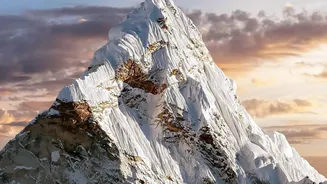
Recent disasters have highlighted an even more complex threat: cascading events. A disaster may begin not with a lake bursting, but with a massive bedrock failure high on a mountain. In August 2026, a catastrophic flood in Nepal was triggered when a huge section of bedrock and the glacier on top of it collapsed. The falling mass of ice and rock travelled with incredible speed, turning into a torrent of mud and water that may have temporarily dammed a river before bursting through with even greater force. This sequence of events—a landslide triggering a flood—shows that the hazards are interconnected. The instability of the mountains themselves is now a primary concern, with warming temperatures weakening the very rock that underpins the glaciers.
Why This Matters for India and the Region
The geography of the Himalayas means that a disaster in one country rarely stays there. The major river systems, including the Gandak/Narayani and Koshi, flow from Nepal into India, linking communities through shared vulnerability. A flood originating in the Nepali mountains can and does cause widespread devastation in downstream states like Bihar and Uttar Pradesh. These trans-boundary risks are a growing concern, affecting millions of people who depend on the Himalayan river basins for their water and livelihoods. The 2023 South Lhonak GLOF in Sikkim was a powerful reminder of how quickly these disasters can escalate within India itself. Recognising this shared threat, there are growing calls for stronger cross-border cooperation on early warning systems and data sharing between Nepal, India, and China to mitigate the impact on vulnerable downstream communities.