







What Is Happening Deep Below?
Roughly 2,200 kilometres under our feet lies Earth's outer core, a superheated ocean of liquid iron and nickel. The constant churning of this metallic fluid acts like a giant dynamo, generating the magnetic field that shields our planet from harmful solar
radiation. For decades, scientists observed this flow moving in a relatively predictable westward direction. But new analysis of satellite and ground data revealed a dramatic shift. Around the year 2010, a massive section of this flow beneath the equatorial Pacific slowed its westward drift and began moving strongly eastward. This sudden reversal has surprised the scientific community, which had long considered the core's large-scale movements to be far more stable.
The Pacific Anomaly
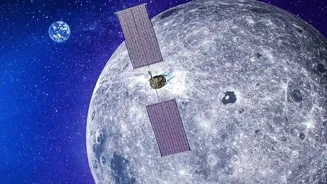
The location of this event, deep under the Pacific, is significant. While much of the core's flow contributes to a general westward drift, the dynamics in this specific region have proven to be more volatile. The reversal was not a minor eddy; it was a large-scale event affecting a broad area of the core. Data from several satellite missions, including the European Space Agency's Swarm constellation, were crucial in detecting this change. These satellites measure tiny variations in the planet's magnetic field, allowing researchers to infer the motion of the liquid iron deep inside. The precision of this data helped confirm that this was a genuine and significant shift in the planet's deep interior.
A Link to 'Geomagnetic Jerks'?
This core-flow reversal didn't happen in isolation. Scientists believe it may be connected to phenomena known as “geomagnetic jerks.” These are sudden, sharp, and unpredictable accelerations in the Earth's magnetic field that occur every few years. One such jerk was recorded in 2017, and the timing suggests a possible connection to the turbulence below the Pacific. The current leading theory is that these jerks are caused by hydromagnetic waves released from deep within the core. Blobs of molten material may rise and release energy, creating waves that ripple up to the surface of the core and cause abrupt changes in the magnetic field we observe. The Pacific flow reversal is seen as a powerful example of the dynamic processes that can trigger such events.
The Central Mystery Remains
Despite the wealth of new data, the ultimate cause of the 2010 flow reversal remains unexplained. Scientists are investigating several possibilities. One hypothesis suggests a link to activity even deeper within the planet, noting that the reversal was contemporary with observed changes in the behaviour of Earth's solid inner core. This raises intriguing questions about how the different layers of Earth's interior might be connected. Researchers are now trying to determine if this reversal was a one-off event, a short-lived fluctuation, or part of a longer, repeating cycle of core activity. The latest data suggests the eastward flow has already started to weaken since 2020, lending weight to the idea that it could be an oscillation rather than a permanent new state.
Why This Matters for Us
While these events are happening thousands of kilometres beneath us and pose no immediate danger, they are fundamentally important to understanding how our planet works. The magnetic field is our primary defence against damaging space weather, and its long-term stability is crucial for our technology-dependent society, from global navigation systems to power grids. This discovery that the core can change so rapidly—over the span of a decade rather than millennia—forces us to rethink our models of the Earth's interior. It is a humbling reminder that our planet is a living, breathing system with powerful forces at play, many of which we are only just beginning to comprehend.