






The Power of Sunlight
To understand how a solar panel works, we first have to understand light itself. Sunlight isn't just a warm glow; it's made of tiny packets of energy called photons. These photons travel millions of kilometres from the sun to Earth. Every hour, enough
of these energy packets strike our planet to theoretically power the entire globe for a year. Solar panels are designed specifically to catch these photons and harness their energy. The entire process relies on a phenomenon known as the photovoltaic effect, which is the direct conversion of light into electricity at an atomic level. It’s a physical process, not a chemical one, meaning it doesn't burn fuel or create emissions.
The Heart of the Panel: The Solar Cell
The fundamental building block of a solar panel is the photovoltaic (PV) cell. These cells are typically made from silicon, a semiconductor material that is abundant and durable. But pure silicon isn't a great conductor of electricity on its own. To make it work, manufacturers modify the silicon through a process called doping. They create two distinct layers. One layer, the n-type (negative), is doped with an element like phosphorus, which has extra electrons. The other layer, the p-type (positive), is doped with an element like boron, which has 'holes' where electrons should be.
Creating a One-Way Street for Electrons
When these two silicon layers—the n-type and p-type—are placed together, they form what is called a P-N junction. At this junction, a remarkable thing happens. The extra electrons from the n-type layer naturally move across to fill the 'holes' in the p-type layer. This movement creates a thin, electron-depleted zone at the junction and, crucially, establishes a permanent internal electric field. This field acts like a one-way street or a slide, creating a permanent directional force. Without this field, any energy created would be lost as heat. With it, the cell is primed and ready to direct the flow of electricity.
From Photons to Electric Current
Now, the stage is set for the photovoltaic effect to take place. When a photon from the sun strikes the solar cell, it transfers its energy to an electron in the silicon, knocking it loose from its atom. This freed electron is then pushed by the internal electric field at the P-N junction toward the n-type side, while the 'hole' it left behind is pushed to the p-type side. This forced separation of charges creates a voltage difference across the cell. When the top and bottom of the solar cell are connected by wires, these free-flowing electrons have a path to travel, creating an electric current. This flow of electrons is what we know as electricity.
Making the Electricity Usable
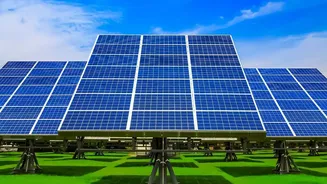
The electricity generated by a single solar cell isn't very much, so multiple cells are wired together to form a solar panel, or module. Multiple panels are then connected into an array to produce a significant amount of power. However, this electricity is in the form of direct current (DC), where electrons flow in one direction. Our homes and appliances run on alternating current (AC), where the flow of electrons reverses direction many times per second. This is where a crucial component called an inverter comes in. The inverter takes the DC electricity from the solar panels and converts it into usable AC electricity, ready to power your lights, fans, and electronics.