






The Two Paths to Mind Reading
Brain-computer interfaces, or BCIs, are technologies designed to create a direct pathway between the brain and an external device. For years, this field has been split into two main camps. First, there are invasive methods, like Elon Musk's Neuralink,
which involve surgically implanting electrodes directly into the brain. This approach offers incredibly high accuracy, capable of reading the signals from individual neurons, but it comes with significant risks like infection and the complexities of brain surgery. On the other side are non-invasive methods. These systems, such as caps that read electroencephalography (EEG) signals from the scalp, are much safer and more accessible. However, their major drawback has always been a lack of precision. The skull and tissue between the sensors and the brain weaken and distort the signals, making it difficult to decode complex information accurately. This difference in performance is the “accuracy gap” that has kept non-invasive BCIs largely in the realm of research labs.
How Meta's New System Works
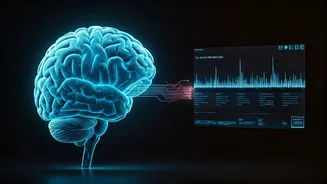
Meta's new system, called Brain2Qwerty v2, represents a breakthrough for the non-invasive camp. It uses a technology called magnetoencephalography (MEG), which measures the tiny magnetic fields produced by the brain's electrical activity. While still non-invasive, MEG provides a cleaner signal than traditional EEG. In a recent study, nine volunteers wore an MEG device for about 10 hours each while they typed sentences. This process generated a massive dataset of brain activity paired with the corresponding text—over 22,000 sentences in total. The secret sauce is a sophisticated AI model that was trained on this data. The model works in a hierarchical fashion: one part of the AI translates the raw brain signals into characters, another organizes them into words, and a large language model (LLM) helps assemble these words into coherent sentences, correcting errors based on semantic context.
A Leap in Accuracy
The results of this new system are what truly set it apart. Brain2Qwerty v2 achieved an average word accuracy of 61%, a dramatic improvement over the roughly 8% accuracy of previous non-invasive methods. For the best-performing participant, the system reached an impressive 78% word accuracy, meaning more than half of the sentences decoded from their brain activity had only one word error or less. This is a significant narrowing of the performance gap with invasive implants, achieved without a single incision. Crucially, the researchers found that the system's accuracy improves predictably as it is fed more training data. This “scaling law” suggests that the gap could be closed even further simply by collecting more data, potentially transforming patient care by offering a viable alternative to neurosurgery.
From the Lab to Real Life
The primary motivation behind this research is to restore communication for people who have lost the ability to speak due to conditions like ALS, stroke, or brain injuries. While the current system decodes brain signals associated with the motor action of typing, the long-term vision is to apply this to imagined speech, offering a voice to those who have lost theirs. By open-sourcing the code, Meta hopes to accelerate research across the entire neuroscience community. Beyond medicine, this technology could one day power the next generation of computing interfaces. Imagine controlling augmented reality glasses or other devices simply with your thoughts, providing a truly hands-free experience. However, this future is still a long way off. A major hurdle is the hardware itself; MEG scanners are currently large, room-sized machines that are completely impractical for daily use. While more portable MEG sensors are in development, they are not yet ready for widespread deployment.