
Our Microbial Travel Companions
A new study led by NASA scientists has mapped out potential “survivable niches” where certain microbes from Earth could persist on the Moon. Published in the journal Science Advances, the research simulated conditions at three candidate landing sites
for the upcoming Artemis missions near the lunar South Pole. The team focused on five types of microbes known for their resilience and common presence on spacecraft and human skin, including the fungi Aspergillus niger (a type of black mould) and bacteria like Deinococcus radiodurans. The results were surprising: these organisms, even some not typically considered “extremophiles,” could potentially survive for days or even weeks in specific lunar locations.
Why the South Pole is Different
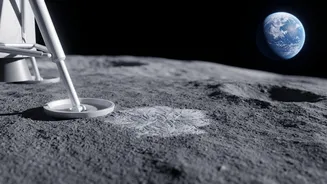
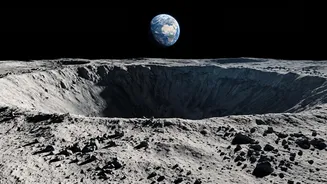
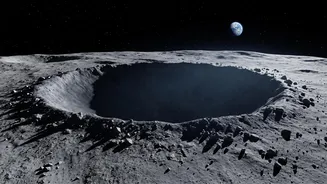
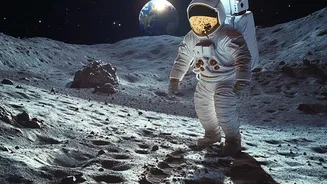
The key to this potential survival lies in the unique environment of the Moon's polar regions. Unlike the lunar equator, which endures extreme temperature swings and direct, intense ultraviolet (UV) radiation, the South Pole is a land of long shadows. The sun hangs permanently low on the horizon, meaning the floors of many craters are never touched by direct sunlight. These Permanently Shadowed Regions (PSRs) are incredibly cold and shielded from the most damaging forms of radiation, creating small pockets where microbes might find refuge. The study found that even outside these PSRs, the terrain itself—the slopes of crater walls or even an astronaut's bootprint—can create tiny shaded areas that offer enough protection for microbes to persist.
Survival, Not Habitation
It’s crucial to understand that scientists are talking about survival, not thriving. The models show that these microbes would enter a dormant, suspended state called cryptobiosis to withstand the harsh conditions. There is no evidence the Moon has the key ingredients for microbial growth and replication, most notably liquid water and a protective atmosphere. However, the fact that they can survive at all is a significant finding. The fungus Aspergillus niger, commonly found in our bathrooms, proved to be the most resilient in the simulations, capable of withstanding even some UV exposure. In some modeled areas, it could potentially survive for more than a week.
Implications for Planetary Protection
These findings have major implications for the future of space exploration, particularly for a principle known as “planetary protection.” The goal is to avoid contaminating other celestial bodies with Earth life (forward contamination) and to protect Earth from anything potentially harmful brought back from space (backward contamination). If we are to search for signs of ancient lunar chemistry or even past life on the Moon or Mars, we need to be sure we aren't just finding our own microbial baggage. This research underscores the need for strict contamination control protocols for the Artemis missions and any future lunar habitats. Scientists need a clear baseline of what the Moon is like before a sustained human presence changes it forever. As we establish a foothold on the Moon, it will become increasingly difficult to tell the difference between native lunar geology and contamination we brought with us.
A Natural Laboratory
While contamination is a concern, the study's authors also see an opportunity. The Moon's unique environment, with its extreme cold and radiation, can serve as a natural laboratory. It provides a perfect, if imperfect, setting to test the absolute limits of microbial survival in conditions that are impossible to fully replicate on Earth. By carefully studying how our microbial companions fare in these harsh niches, we can learn more about the fundamental boundaries of life itself. This knowledge is not just critical for preserving the scientific integrity of lunar exploration but also for informing the search for life elsewhere in the cosmos, from the icy moons of Jupiter to the dusty plains of Mars.