


A New View of Our Star
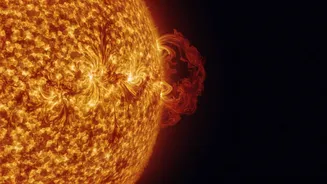
Scientists are celebrating a groundbreaking new image of the Sun, captured by the National Science Foundation's Daniel K. Inouye Solar Telescope in Hawaii. Hailed as the highest-resolution image of the Sun's surface in visible light, it provides a level
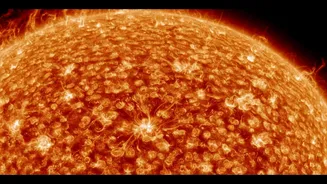
of detail never before seen. While the telescope is an NSF facility, NASA scientists are deeply involved in analyzing its data to better understand our star. The image reveals the Sun's photosphere—its visible surface—as a complex, textured pattern of golden, cell-like structures that has been compared to boiling water or shimmering gold.
What Are Solar Granules?
Those cell-like structures are known as solar granules. Each one is a vast bubble of hot, electrified gas, or plasma, rising from the Sun's interior. To grasp their immense scale, imagine a single granule stretching across an area the size of Texas or even larger. The center of a granule is bright because it contains scorching plasma welling up from below. As this plasma reaches the surface, it spreads out, cools, and sinks back down along the darker edges, known as intergranular lanes. This entire process is a form of convection, similar to what happens in a pot of boiling soup, but on a cosmic scale, with millions of granules covering the Sun at any given time.
Secrets in the Shadows
Previous images of the Sun showed these granules, but the boundaries between them appeared blurry. This new, ultra-sharp view changes everything. Scientists can now see features as small as 20 kilometres across. The key discovery is the confirmation of a phenomenon called the Kelvin-Helmholtz instability (KHI), which was long theorized but never directly observed on the Sun's surface. This instability occurs where fluids moving at different speeds meet, creating distinctive swirls and vortices. In the new images, these tiny, whirlpool-like patterns are clearly visible in the dark lanes between the granules, where cooling plasma sinks back into the Sun.
A 'Beautiful' and Important Discovery
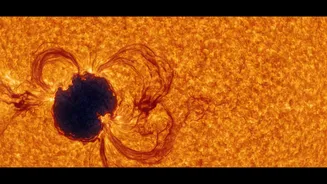
Observing these vortices is more than just an academic curiosity. Scientists believe these small-scale dynamics play a huge role in the Sun's overall behaviour. The swirling motions may be a key mechanism for transferring energy from the Sun's surface up into its incredibly hot outer atmosphere, the corona. Understanding how the corona is heated has been a decades-long mystery in solar physics. Furthermore, these tiny whirlpools could help explain how magnetic energy is stored and then violently released, leading to much larger events.
Why It Matters for Earth
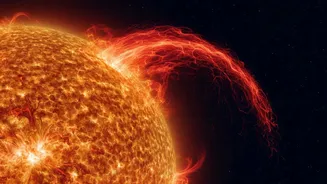
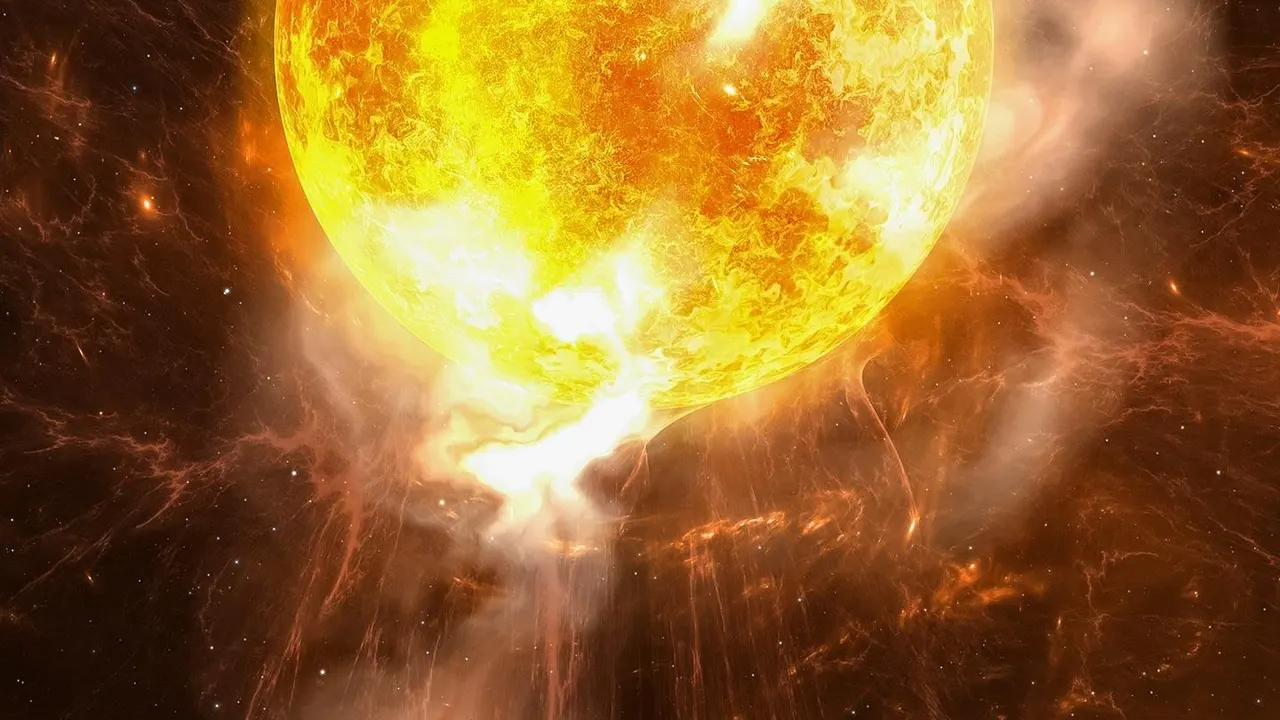
Studying the Sun's behaviour isn't just about understanding a distant star; it's about protecting our way of life on Earth. Violent events on the Sun, such as solar flares and coronal mass ejections (CMEs), can send waves of charged particles and radiation hurtling towards our planet. This phenomenon, known as space weather, can disrupt GPS signals, damage communication satellites, and even overload power grids. By understanding the fundamental physics of the Sun at the granular level, scientists hope to build better models for predicting this potentially dangerous solar activity. This new image provides a crucial piece of the puzzle, linking the smallest features on the Sun to the massive events that can impact us all.