

A New Era of Solar Viewing
This unprecedented look at our star comes from the National Science Foundation's Daniel K. Inouye Solar Telescope, located on Haleakalā in Hawaii. As the world's most powerful solar telescope, its massive 4-meter mirror allows it to capture the Sun's
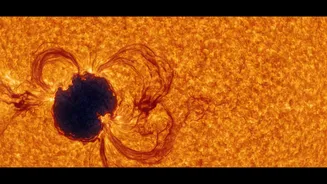
surface, or photosphere, with astonishing clarity. Recent images, including some highlighted by NASA, are the highest-resolution views ever taken in visible light. They allow scientists to see structures as small as 20 kilometres across, a feat comparable to spotting a small coin from nearly 200 kilometres away. This powerful tool is a collaboration involving multiple institutions, providing crucial data that helps NASA scientists and researchers worldwide probe the Sun's deepest secrets.
The Sun's 'Boiling' Surface
The images reveal a dramatic, cobblestone-like pattern across the Sun. These are solar granules, the tops of massive convection cells. Think of it like a pot of boiling water, but on a colossal scale. Each granule is a bubble of searing-hot plasma, some as large as the state of Texas, rising from the Sun's interior. The bright centre is where hot material reaches the surface, cools, and then sinks back down along the darker, cooler edges known as intergranular lanes. This entire process is incredibly dynamic; a single granule lasts for only about 8 to 20 minutes before dissipating and being replaced by a new one, part of a constant, roiling motion that covers the entire star.
From Blurry to Breathtaking Detail
For decades, these granules appeared as blurry, shifting shapes. Now, for the first time, scientists can see the incredible detail within and between them. The new images show fine, thread-like magnetic structures and swirling vortices at the edges of the granules. Researchers have even confirmed the existence of a long-theorized process called the Kelvin-Helmholtz instability, where streams of plasma flowing at different speeds create wave-like swirls. These previously invisible details are crucial because the dark lanes between granules are where the Sun's magnetic fields become concentrated. Seeing how these magnetic fields interact with the churning plasma is key to understanding the Sun's behaviour.
Unlocking Solar and Space Weather Secrets
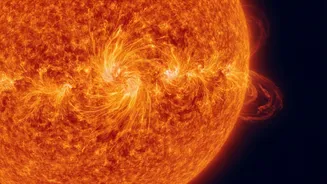
This fine-scale view does more than just produce beautiful pictures; it helps solve fundamental mysteries. By studying how energy is transferred through granules and how magnetic fields are twisted and stretched in the process, scientists can build better models of the Sun. This is critical for understanding space weather. The same magnetic forces that are shaped by granulation on a small scale can eventually build up and unleash massive solar flares and coronal mass ejections (CMEs). These powerful solar eruptions send charged particles hurtling through space, and if they are aimed at Earth, they can have significant consequences.
Why This Research Matters on Earth
Understanding the micro-level physics of the Sun has very real-world applications. Severe space weather events can disrupt our GPS and communication satellites, damage power grids, and pose a risk to astronauts in orbit. By observing the root causes of this activity in the finest detail, scientists hope to dramatically improve their ability to forecast these events. Better predictions mean more time to take protective measures, such as adjusting satellite orbits or preparing utility networks for potential surges. These images from the Inouye telescope are more than just a portrait of our star; they are a vital tool for safeguarding our technologically dependent society.