




A Ghost in the Machine
Imagine sending a signal deep into a colossal ice sheet, thousands of metres thick, and getting a response that suggests a massive, hidden world. For years, glaciologists using ice-penetrating radar have seen strange, compelling images bounce back from
the depths of Antarctica and Greenland. These signals sometimes looked like vast subglacial lakes, hidden mountain ranges, or other unexplained geological formations. In some cases, strange, plume-like distortions appeared deep within the ice, suggesting something was pushing up from below. These 'ghost' images spurred excitement and debate, representing potential major discoveries about the world locked away beneath the ice.
The Scientific Plot Twist
However, the latest analyses are revealing a surprising twist. Many of these mysterious radar returns are not from features under the ice, but from the complex internal structure of the ice itself. Scientists now believe that what they were seeing is a phenomenon known as 'incoherent scattering'. This occurs when the radar waves don't bounce off a single, solid surface (like a bedrock floor) but are instead scattered by millions of tiny variations within the ice column. This scattering creates a 'texture' in the radar data that can mimic the appearance of a physical object, leading to misinterpretation. It’s like seeing a face in the clouds; the shape is real, but its source is not what it first appears to be.
Understanding Ice 'Texture'
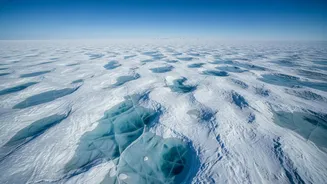
So, what is this 'glacier texture'? As snow falls and compacts over thousands of years to form glacial ice, it doesn't create a uniform block. The immense pressure and slow, grinding flow of the glacier cause ice crystals to align in specific ways. This alignment, known as 'crystal orientation fabric,' is not uniform throughout the ice sheet. There are also subtle variations in density, trapped dust or ash layers, and even small amounts of liquid water that can cause scattering. When radar waves pass through these zones of varying crystal alignment and density, they scatter in complex patterns. The returning signal is a jumble that the equipment interprets as a distinct feature, when in fact it's just the noisy echo of the ice's own intricate internal fabric.
Why the Correction Matters
Correcting this interpretation is more than just a scientific technicality; it has profound implications for climate science. Accurately understanding what lies beneath glaciers is critical for predicting how they will move and melt. A smooth, flat bedrock allows a glacier to slide faster than a rough, mountainous one. Likewise, the presence of subglacial lakes can lubricate the base of the ice, accelerating its journey to the sea. If scientists mistake ice texture for a subglacial mountain, their models for ice flow will be wrong. Refining these radar interpretations is essential for improving our predictions of global sea-level rise, a critical issue for coastal communities worldwide, including in India. This new understanding allows researchers to create more accurate maps of both the ice's internal structure and the true nature of the bedrock below, leading to better forecasts.