





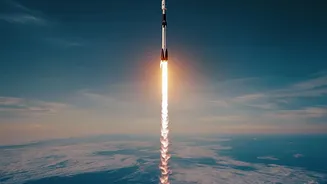
From High-Altitude Hops to Orbit
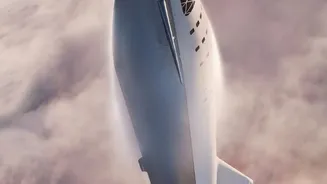
Until now, Starship's journey has been defined by suborbital tests. Think of these as enormous vertical leaps. Prototypes would soar several kilometres up, perform a complex, belly-flop-style descent, and then reignite their engines to attempt a vertical landing.
These tests were crucial for proving the Raptor engines, the vehicle's structural integrity, and the unprecedented landing maneuver. However, they never achieved the velocity needed to circle the Earth. A suborbital flight goes up and comes back down in a high arc; an orbital flight achieves enough horizontal speed—around 28,000 km/h—that as it falls, the Earth curves away beneath it, allowing it to stay in space.
The First True Orbital Mission
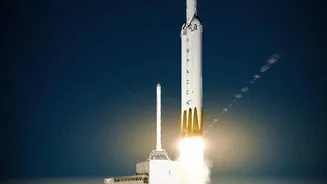
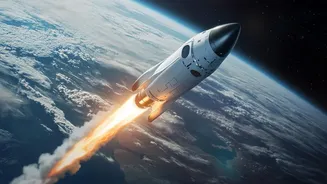
The 14th test flight on September 28, 2026, was designed from the ground up as an orbital mission. This wasn't just about going higher; it was about going faster than ever before and staying there. The flight plan involved the Super Heavy booster propelling the Starship upper stage to near-orbital speeds, separating, and then the Starship firing its own engines to make that final push into a stable orbit. Despite one engine on the booster and one on the ship shutting down early, the vehicle demonstrated its resilience and successfully achieved orbit. This success unlocked the mission's next major objective: deploying a payload.
A Working Payload for the First Time
This flight wasn't just a joyride. For the first time, Starship acted as a true cargo delivery system, deploying 26 Starlink V3 satellites into an operational orbit. Previous flights had carried test payloads or mock satellites, but these were active, revenue-generating additions to SpaceX's internet constellation. This demonstrates a core part of Starship’s business case: its ability to launch significantly more, and larger, satellites than the company's workhorse Falcon 9 rocket. Successfully deploying this payload proves the vehicle is not just a test article, but a functional spacecraft capable of doing real work.
Mastering Critical New Maneuvers
Achieving orbit required nailing manoeuvres that are far more complex than those in suborbital hops. A key example is "hot staging," where the Starship upper stage ignites its engines before fully separating from the Super Heavy booster. This risky but efficient technique, which boosts payload capacity by about 10%, was executed successfully. Furthermore, after coasting in orbit, the ship had to relight an engine to perform a deorbit burn—a critical step for a safe return. It then endured the intense heat of atmospheric re-entry, testing its thermal protection system under orbital conditions before splashing down in the Pacific Ocean. Although the mission was cut short from its planned ten hours to about three as a precaution, these end-to-end steps were all demonstrated.
What This Unlocks for the Future
Reaching orbit changes the entire trajectory of the Starship program. It’s the foundational capability needed for all of SpaceX's ambitious goals. This includes launching hundreds of next-generation Starlink satellites at a time, fulfilling its contract with NASA to land Artemis astronauts on the Moon, and ultimately, building a self-sustaining city on Mars. The Artemis missions, for example, require a lunar-rated Starship to be refuelled in Earth orbit by a fleet of other Starships—a feat that is impossible without first mastering orbital flight. While full reusability and booster catches are still goals to be perfected, proving the vehicle can reach orbit and return is the single most important step toward making those ambitions a reality.