





An Unexpected Discovery
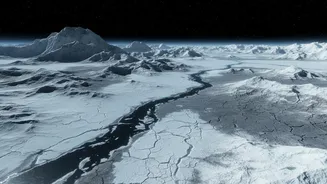
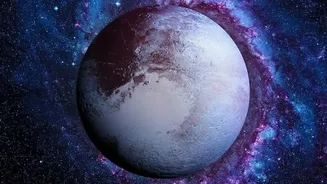
When NASA's New Horizons spacecraft flew by Pluto in 2015, it sent back images that transformed our view of the distant world. Instead of a simple, frozen rock, we saw a complex and active landscape. One of the most captivating features is Sputnik Planitia,
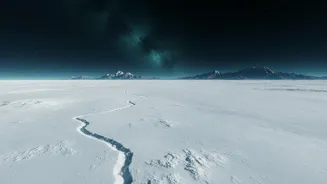
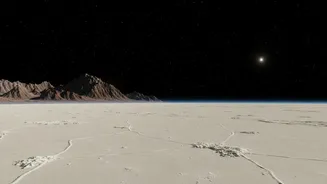
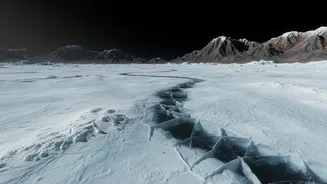
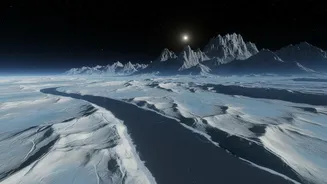
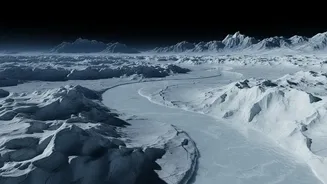
the western lobe of Pluto's famous heart-shaped region. This enormous basin, larger than Texas and Oklahoma combined, is a vast glacier of frozen nitrogen. A new analysis of these decade-old images has revealed something astonishing: dark, linear streaks and diffuse patches along the glacier's northern edge that look just like areas on Earth's glaciers that have been wetted by water.
The Earthly Comparison
To understand the excitement, we first need to look at our own planet. On Earth's ice sheets, like in Greenland, similar dark features appear where liquid water is present. This can happen when surface snow melts or when water from beneath the ice emerges. The liquid water changes the way light reflects off the surface, making it appear darker. It can also enlarge the grains of ice and snow, which further reduces reflectivity. When scientists from the Southwest Research Institute compared the New Horizons images of Pluto with NASA satellite imagery of Greenland, the resemblance was unmistakable. The patterns on Sputnik Planitia are concentrated in depressions and follow local topography, just as water flows do on Earth.
Not Water, But Liquid Nitrogen
So, does this mean there's liquid water on Pluto's surface? The answer is a definitive no. Pluto's surface is incredibly cold, making liquid water impossible. Scientists also determined that liquid nitrogen rain is physically impossible in Pluto's thin atmosphere. Instead, they propose a fascinating alternative: the dark streaks are caused by liquid nitrogen welling up from beneath the glacier. The theory is that pressure at the base of the massive nitrogen ice sheet could cause some of it to melt. This liquid nitrogen could then be forced up through cracks and fractures in the ice, briefly flowing onto the surface before freezing again. This would 'wet' the nitrogen ice, darkening it just as water darkens snow on Earth.
A Geologically Active World
This discovery is the first evidence of recently flowing liquid of any kind on Pluto's surface. It adds to a growing body of evidence that the dwarf planet is not the geologically dead world many once assumed it to be. The surface of Sputnik Planitia is thought to be quite young, likely less than a million years old, which means these features must have formed recently in geological terms. The glacier itself is in constant, slow motion, with city-sized convection cells of nitrogen ice churning over millions of years. The liquid nitrogen flows appear to be happening along the boundaries of these cells. These dark patches aren't the only intriguing features; other areas of Pluto are covered in complex organic molecules called tholins, which are created when sunlight interacts with methane and nitrogen, giving parts of the planet a reddish hue.
Why The Comparison Matters
The fact that different processes on two vastly different worlds can create such similar-looking features is a lesson in planetary science. It demonstrates that the same physical principles are at play across the solar system, even when the ingredients are wildly different—liquid water on Earth versus liquid nitrogen on Pluto. This finding also suggests a new kind of time-variable feature on Pluto, something that might change over seasons or even shorter timescales. While the evidence for liquid nitrogen flows is strong, it remains indirect for now. Scientists say that more lab work and, ideally, future high-resolution mapping missions are needed to confirm the theory and to see if similar features exist elsewhere on the distant world.