





The Mission and Its Crew
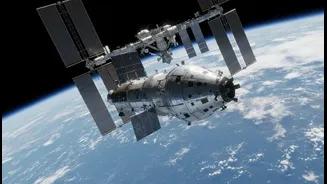
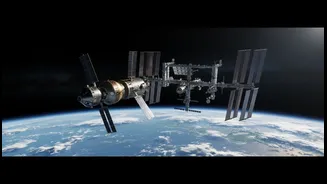
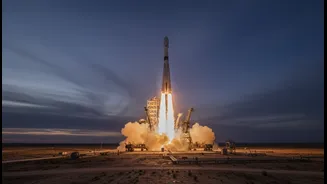
The Soyuz MS-29 spacecraft lifted off from the Baikonur Cosmodrome on July 14, 2026, beginning a fast-track, three-hour journey to the International Space Station (ISS). The mission delivers three new crew members for a long-duration stay that will span
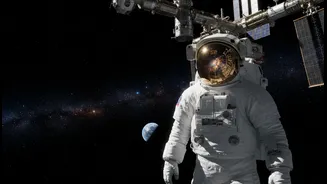
Expeditions 74 and 75. The crew consists of two Roscosmos cosmonauts, Commander Pyotr Dubrov and Flight Engineer Anna Kikina, and NASA astronaut Anil Menon. For Menon, this is his first journey to space, while it marks the second spaceflight for both Dubrov and Kikina. Their mission is slated to last approximately eight months, with a planned return to Earth in April 2027. The successful launch and docking continue a long tradition of international cooperation in low Earth orbit.
The Doctor-Engineer in the Stars
The focus of this mission is NASA's Anil Menon, an emergency medicine physician with a master's degree in mechanical engineering and a colonel in the U.S. Space Force. Born to Indian and Ukrainian immigrants, Menon's unique combination of skills makes him exceptionally suited for the challenges of long-duration spaceflight. Before becoming an astronaut, he served as SpaceX's first flight surgeon, helping to launch the first commercial crewed mission, and was a flight surgeon for previous ISS expeditions. His experience extends to being a first responder at disaster sites like the 2010 Haiti earthquake and serving in the military. This diverse background provides him with the practical and theoretical knowledge needed to conduct complex medical experiments while also maintaining the health of the crew far from Earth.
An Ambitious Science Agenda
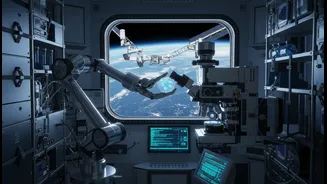
Over the next eight months, Menon and his crewmates will conduct a wide array of scientific research. A key focus is on human health in space. Experiments include studying how blood flow changes in microgravity and testing ultrasound scans assisted by augmented reality and artificial intelligence, which could one day allow for autonomous medical care on deep-space missions. Another significant area of research involves materials science, specifically growing semiconductor crystals. The near-perfect vacuum and microgravity of space may allow for the creation of flawless crystals for use in advanced computing and medical devices back on Earth. The crew will also explore bioprinting vascular structures to better understand ageing and improve future medical treatments.
The Challenge of Eight Months in Orbit
Living and working in space for over half a year takes a significant toll on the human body. Without Earth's gravity, astronauts experience muscle atrophy, bone density loss, and shifts in bodily fluids that can affect their vision and cardiovascular systems. These long-duration missions are crucial for understanding and mitigating these effects, which is a primary reason for sending a physician like Menon. This mission, lasting about 261 days, is long but not a record; cosmonaut Valeri Polyakov spent 438 days aboard the Mir space station in the mid-1990s. Each long-duration mission builds on the knowledge gained from previous ones, gathering vital data to ensure astronauts can stay healthy on even longer journeys to the Moon, Mars, and beyond.
Paving the Way for Future Exploration
The Soyuz MS-29 mission represents more than just another crew rotation. It is a critical step in preparing humanity for a sustained presence beyond Earth. The research on creating medical supplies from the station's water supply, developing advanced materials, and understanding the deep physiological changes of spaceflight are all essential for planning future deep-space voyages. The presence of a doctor-engineer like Anil Menon underscores the increasing complexity of orbital science and the need for multi-talented astronauts. The collaboration between NASA and Roscosmos on this flight also highlights the continued importance of the ISS as a symbol of global partnership in the pursuit of knowledge.