



The Standard Story: A Giant, Fiery Impact
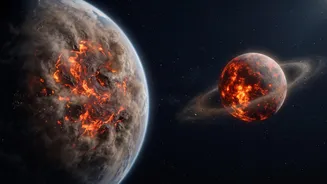
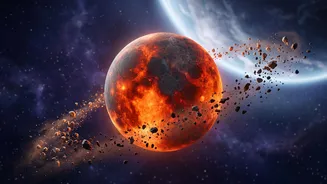
For many years, the leading theory for the Moon's origin has been the Giant-Impact Hypothesis. The story goes like this: about 4.5 billion years ago, a Mars-sized protoplanet, nicknamed Theia, slammed into a young, molten Earth. This cataclysmic event
ejected a massive amount of vaporized rock and debris into orbit. Gravity then went to work, pulling this swirling ring of material together over thousands or millions of years to form the Moon we see today. This theory elegantly explains several key features of the Earth-Moon system, such as the Moon's lack of a large iron core and the system's high angular momentum. Early computer simulations of this event treated both Earth and Theia as if they were fluids, assuming the sheer energy of the impact would make their material strength irrelevant.
A Complication in the Cosmic Recipe
Despite its strengths, the Giant-Impact Hypothesis has a nagging problem: the Moon and Earth are too similar. Geochemical analysis of lunar rocks, brought back by the Apollo missions, shows their isotopic signatures are almost identical to Earth's. If the Moon formed mostly from the debris of Theia, as many models suggested, it should have a distinct chemical fingerprint. Scientists have struggled to explain this twinning. Why does the Moon look like it's made almost entirely of Earth material, when a glancing blow from another world should have resulted in a mix? This has led to creative new theories, but a recent breakthrough came from questioning a fundamental assumption of the original model.
Rethinking the 'Fluid Worlds' Assumption
New research, published in recent scientific journals, challenges the idea that the two colliding bodies behaved entirely like fluids. A team of scientists from institutions like the Southwest Research Institute and the University of Arizona ran new, more sophisticated simulations. For the first time, they factored in the material strength of the proto-Earth and Theia—essentially, treating them more like solid, rocky bodies than simple drops of liquid. They discovered this seemingly small change had a massive effect on the outcome. The strength of a planet's rock depends on its temperature; hotter rock is weaker, while colder rock is stronger. This geological property, previously overlooked, turned out to be a key variable in the Moon's creation story.
What This Means in Practice
The practical implications are profound. When the simulations were run with temperature-dependent material strength, two very different outcomes emerged. If Theia was relatively cool and strong, the collision would indeed create a disk of debris that slowly forms a Moon, similar to the classic model. But if Theia was hotter and weaker (though still mostly solid), the simulations produced a startling result: the collision could create a large, intact Moon-sized body that was thrown directly into orbit in a matter of hours, not millennia. This suggests the Moon might have been born almost instantly, not gradually assembled. This rapid formation pathway could help explain the Moon’s tilted orbit and thin crust, features that have been difficult to account for.
A New Link Between 'How' and 'When'
This new understanding connects the how of the Moon’s formation with the when. Since young protoplanets are hot and cool over millions of years, the temperature of Theia at the time of impact becomes crucial. A hotter, weaker Theia would favor the 'intact Moon in hours' scenario, suggesting the collision happened relatively early in the solar system's history. A colder, stronger Theia would favor the 'debris disk' model, pointing to a later impact. By studying the Moon's properties today, scientists may be able to work backward to determine which formation path is more likely and thus pin down a more precise timeline for this monumental event. It transforms the question from a simple collision to a complex geophysical event where the state of the planets was just as important as the impact itself.