




An Icon's Unmatched Legacy
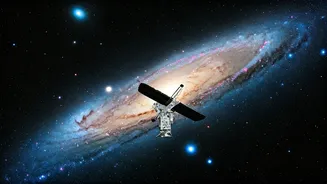
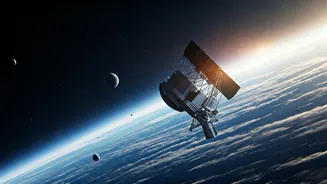
It is nearly impossible to overstate the Hubble Space Telescope's impact. Since its launch in 1990, it has become a household name, fundamentally changing our understanding of the cosmos with its breathtaking images and groundbreaking discoveries. From
helping to determine the age of the universe to providing evidence for supermassive black holes and the mysterious force of dark energy, Hubble has been a pillar of modern astronomy. Its stunning images of nebulae and distant galaxies have not only fueled scientific research but have also captured the public's imagination, becoming cultural touchstones. The telescope, a joint project of NASA and the European Space Agency, was revolutionary for its clarity above Earth's distorting atmosphere and its design for in-space servicing by astronauts, which has kept it at the forefront of science for decades.
Meet the New Contender: Nancy Grace Roman
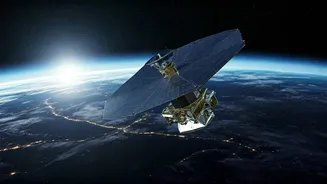
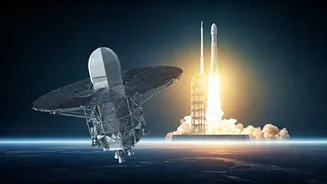
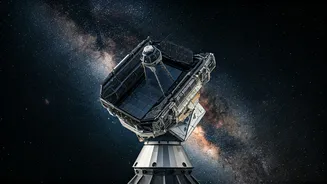
Set for launch on August 30, 2026, NASA's Nancy Grace Roman Space Telescope is not just another telescope; it represents a new philosophy in cosmic observation. Named after Nancy Grace Roman, NASA's first chief of astronomy and the 'Mother of Hubble,' the observatory is designed for one primary purpose: speed and scale. While Hubble is a master of the deep, narrow-field view—painstakingly studying a small patch of sky for days to reveal its secrets—Roman is built for the panoramic shot. It shares Hubble's 2.4-meter mirror size, ensuring comparable image sharpness, but its mission is entirely different. Roman is a survey telescope, designed to map vast regions of the sky with unprecedented efficiency, addressing key questions about dark energy, exoplanets, and infrared astrophysics.
The Power of a Panoramic View
The crucial difference between Hubble and Roman is the field of view. Roman's Wide Field Instrument (WFI) will capture an area of the sky at least 100 times larger than Hubble's cameras can in a single snapshot. Think of Hubble as a magnifying glass, focusing intensely on one object, while Roman is a wide-angle lens capturing the entire landscape. For example, it took Hubble's Wide Field Camera 3 over 400 separate pointings to create a mosaic of a certain sky area; Roman could cover the same area in just two. This ability to image huge swaths of the cosmos with Hubble-like resolution will generate an enormous amount of data.
A Tsunami of Scientific Data
The term 'outpace' in the context of Roman versus Hubble refers directly to this massive data generation. In its more than 30 years of operation, Hubble has produced hundreds of terabytes of invaluable information. Roman is projected to generate that amount of data in less than a year. Some estimates suggest Roman will transmit around 1.4 terabytes of data every single day, about 500 times more than Hubble's daily rate. Over its five-year primary mission, Roman is expected to image over 50 times the amount of sky that Hubble has in its entire three-decade-plus lifetime. This data deluge will enable astronomers to conduct large-scale statistical studies that were previously impossible, moving from observing individual galaxies to analyzing cosmic ecosystems by the millions.
Unlocking New Cosmic Mysteries
What will we do with all this data? Roman's main goals are to tackle some of the biggest questions in cosmology. It will investigate the nature of dark energy, the force accelerating the universe's expansion, by mapping the distribution of billions of galaxies. It will also conduct a massive survey for exoplanets using a technique called gravitational microlensing, which is sensitive to planets far from their stars and even free-floating 'rogue' planets. This will create a statistical census of planetary systems, helping us understand how common solar systems like our own truly are. Beyond its primary missions, Roman will also feature a Coronagraph Instrument, a technology demonstrator designed to directly image giant exoplanets by blocking out the overwhelming light of their host stars.