





A Prime Candidate for Life
In the vast cosmic expanse, the hunt for planets that could harbour life often feels like searching for a needle in a universal haystack. Yet, for nearly a decade, astronomers have kept a close watch on a particularly promising candidate: LHS 1140 b.
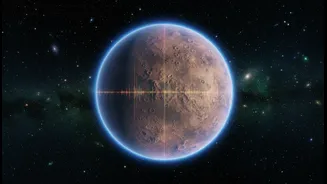
Located just 49 light-years from Earth, this 'super-Earth' is about 5.6 times the mass of our planet and orbits within the 'habitable zone' of its red dwarf star. This so-called Goldilocks zone is the region where temperatures are just right for liquid water to potentially exist on a planet's surface, a key ingredient for life as we know it. Discovered in 2017, LHS 1140 b has all the right statistics on paper: it's a rocky world, not a gas giant, and it receives a reasonable amount of light from its star. These factors made it one of the most compelling targets for follow-up studies with our most powerful telescopes, representing a significant investment of time and resources in the quest to answer one of humanity's biggest questions.
The Telltale Signature of Helium
The latest breakthrough, published in the journal Science in mid-July 2026, didn't come from a direct image of clouds or oceans. Instead, it came from detecting a faint, telltale whisper from the planet's outer edge. Using the Magellan Clay Telescope in Chile, an international team of scientists observed the planet as it transited, or passed in front of, its star. By analysing the starlight that filtered through the very top of the planet's atmosphere, they found the unmistakable signature of helium gas. This helium is slowly escaping the planet's gravity and leaking into space. This might sound like a bad sign, but it's actually the opposite. Helium is a very light gas, and its presence as an escaping element strongly implies that there is a much larger, more substantial atmosphere below that is constantly replenishing it. It's the first time such an atmosphere has ever been concretely confirmed around a rocky planet in a habitable zone.
Reading the Clues, Not Seeing the Surface
This discovery perfectly illustrates the clever, indirect methods astronomers must use to study these distant worlds. We can't simply point a telescope and see the ground conditions on a planet nearly 50 light-years away. Instead, scientists rely on techniques like transmission spectroscopy. When a planet passes in front of its star, the elements in its atmosphere absorb very specific wavelengths of starlight, leaving a unique barcode-like pattern for scientists to read. In this case, the detection of helium provides the crucial 'yes or no' answer to the question of whether an atmosphere exists at all. While the headline is correct—we are studying the upper atmosphere, not the ground—this is not a limitation but a triumph of scientific ingenuity. The escaping helium acts as a tracer, proving a dynamic atmosphere is present. The discovery is a massive return on the technological and financial investment in ground-based observatories and the complex models that predicted this very signature.
A Milestone, Not a Final Answer
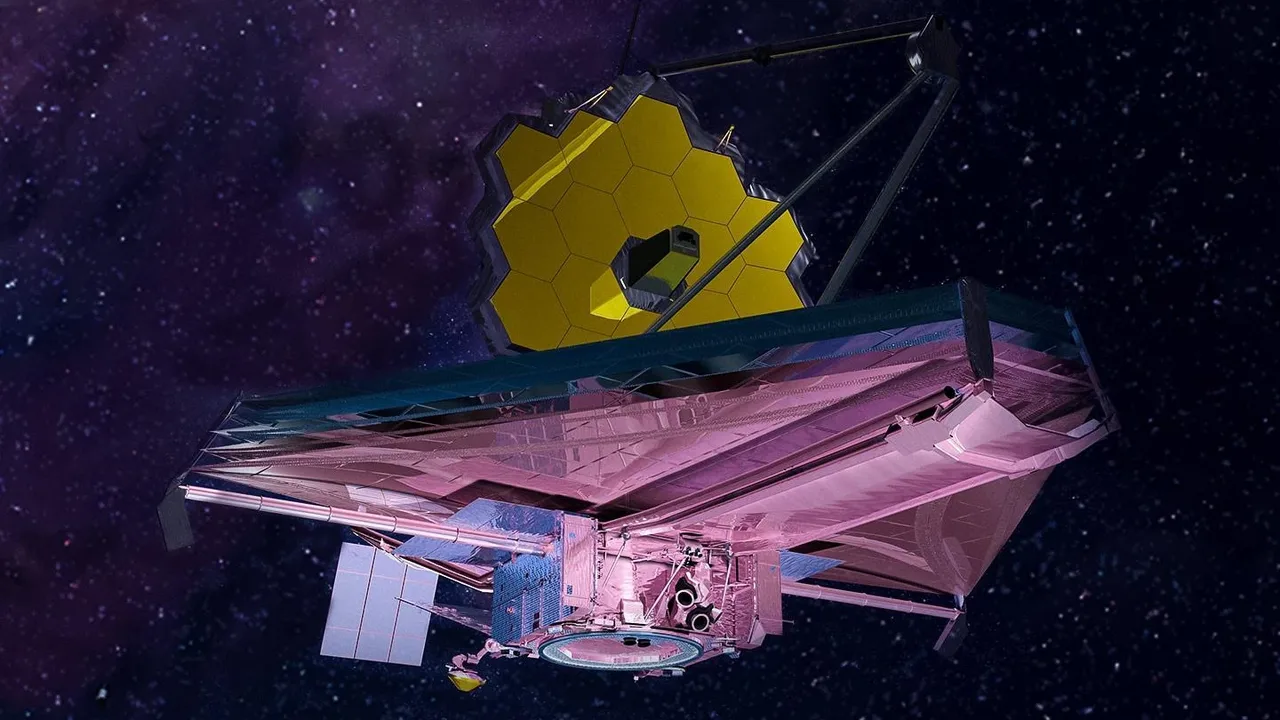
It is crucial to understand what this discovery does and does not mean. At present, there is absolutely no evidence of life on LHS 1140 b. However, the confirmation of a stable atmosphere is a monumental milestone. One of the biggest questions in exoplanet science was whether a rocky planet orbiting a volatile red dwarf star could even hold onto its atmosphere over billions of years. Red dwarfs are known for intense flare activity that can strip atmospheres away. The fact that LHS 1140 b, which is estimated to be over 3 billion years old, has retained its atmosphere is incredibly encouraging for the search for life around the most common type of stars in our galaxy. The next step is to turn even more powerful tools, like the James Webb Space Telescope, toward the planet to analyse its atmosphere in greater detail. Scientists hope to find heavier molecules like nitrogen, or even water vapour, which may be hiding deeper below the helium layer, giving us an even clearer picture of this intriguing world.