

Andromeda: A Cosmic Mirror
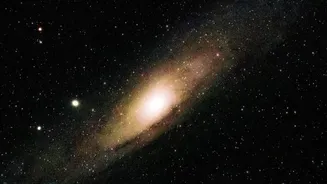
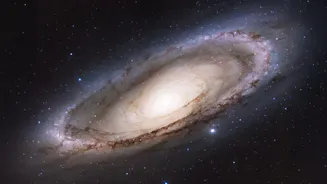
To understand how galaxies evolve, astronomers need a clear view. The problem with studying our own Milky Way is that we are stuck inside it; our view is obstructed by gas, dust, and stars. Andromeda, however, gives us a stunning, top-down perspective.
It is close enough for the Hubble Space Telescope to resolve hundreds of millions of its individual stars, yet far enough away that we can see its entire structure. This unique position allows scientists to create detailed maps of its stellar populations, treating the galaxy as a fossil record of its own history. By analyzing the light from its stars, they can read the story of its past.
The Central Mystery: How Do Galaxies Build Themselves?
The fundamental question driving this research is how large spiral galaxies assemble and change over billions of years. Do they form stars at a steady, constant rate, or in dramatic bursts triggered by major events? Do they grow by consuming smaller satellite galaxies? The answers are written in their stars. Each star's age, color, and location provides a clue. Massive stars burn hot and blue but have very short lives, so their presence signals recent star birth. Less massive, redder stars live for billions of years, providing a look into the more distant past. By mapping these different stellar populations, Hubble allows astronomers to reconstruct Andromeda's life story.
Hubble's Clues: A Story of Boom and Slowdown
Recent studies using vast amounts of Hubble data have painted a dramatic picture of Andromeda's history. About two billion years ago, the galaxy experienced a massive burst of star formation, likely caused by a merger or interaction with another galaxy. This event was incredibly productive, creating a significant fraction of all the stars in the galaxy today. However, since that peak, Andromeda has been winding down. A new analysis published in July 2026 revealed that star formation has been steadily declining over the last 500 million years, with the rate dropping even more sharply in the last 40 million years.
Reading the Rings of History
This slowdown isn't uniform across the entire galaxy. Astronomers found that much of the recent star-forming activity has been concentrated in a prominent ring about 32,000 light-years from the galactic center. The overall decline in star birth is largely driven by decreasing activity within this specific ring. This suggests that the galaxy is not running out of the gas needed to form stars, but is rather entering a quieter phase of its life after a period of intense activity, much like an athlete taking a breather after a marathon. This detailed insight helps scientists refine their models of how galactic structures evolve over cosmic timescales.
Solving the Puzzle of Our Own Galaxy
Ultimately, studying Andromeda is about understanding ourselves. While Andromeda and the Milky Way are similar in size, evidence suggests they've had very different evolutionary paths. Andromeda's history appears to have been more turbulent, with major mergers shaping its development. By comparing our neighbor's more violent past with our own galaxy's relatively calmer history, scientists can better understand the range of pathways a spiral galaxy can take. These studies provide crucial context for our own cosmic home, helping us piece together the past, present, and future of the Milky Way itself.