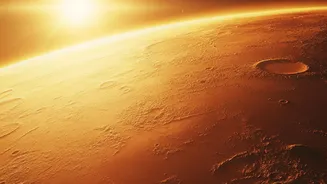






Picture a sunset. You probably imagine a sky painted in brilliant shades of orange and red. But what if you were on Mars? The setting sun would offer a spectacle in a completely different colour: a cool, ethereal blue.
Why Earth's Sunsets Are Red
To understand a blue Martian sunset,
it helps to first remember why Earth's are red. Our planet is wrapped in a relatively thick atmosphere made of tiny gas molecules. As sunlight, which contains all the colours of the rainbow, enters our atmosphere, these molecules scatter the blue light in all directions. This is why our daytime sky looks blue. When the sun is low on the horizon at sunrise or sunset, its light has to travel through much more of the atmosphere to reach our eyes. By the time it gets to us, most of the blue light has been scattered away, leaving the longer wavelengths of red, orange, and yellow to dominate the view.
An Opposite Story on Mars
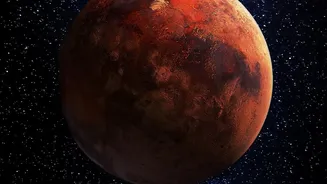
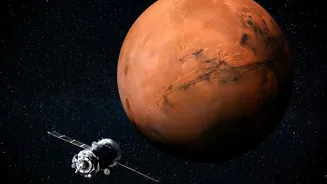
Mars flips this script entirely. The Red Planet has a very thin atmosphere, less than 1% the density of Earth's, and it's mostly carbon dioxide. This thin air means that scattering by gas molecules, the process that makes our sky blue, is much less significant. Instead, the Martian atmosphere is permanently filled with fine dust particles kicked up from its iron-rich surface. This dust is the secret ingredient behind the planet's unique light show. During the day, this dust gives the Martian sky a hazy, butterscotch or tan colour. But at sunset, the magic happens.
The Peculiar Physics of Martian Dust
The key is the size of the Martian dust particles. They are just the right size to scatter light in a very specific way. Instead of scattering blue light everywhere like the molecules in Earth's air, the Martian dust does something called forward scattering. This means it pushes blue light forward, in the same general direction the light was already travelling. Red light, on the other hand, gets scattered more widely across the sky. So, when you look toward the setting sun on Mars, you are looking straight into this focused beam of blue light, which creates a distinct blue halo right around the sun's disk.
A Blue Glow in a Red Sky
It's important to note that the entire Martian sky doesn't turn blue. Rather, a cool, blue-to-white glow appears directly around the setting sun, fading into the more typical butterscotch or pinkish-yellow tones of the wider sky. The effect is most prominent because, at sunset, the sunlight is passing through the greatest amount of dust-filled atmosphere, amplifying this forward-scattering effect. The longer the light's path through the dust, the more the red light is filtered out, allowing the blue to become much more prominent to an observer looking toward the sun.
Seeing Is Believing
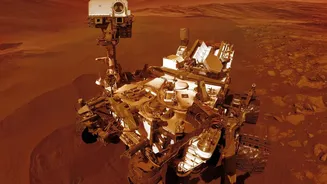
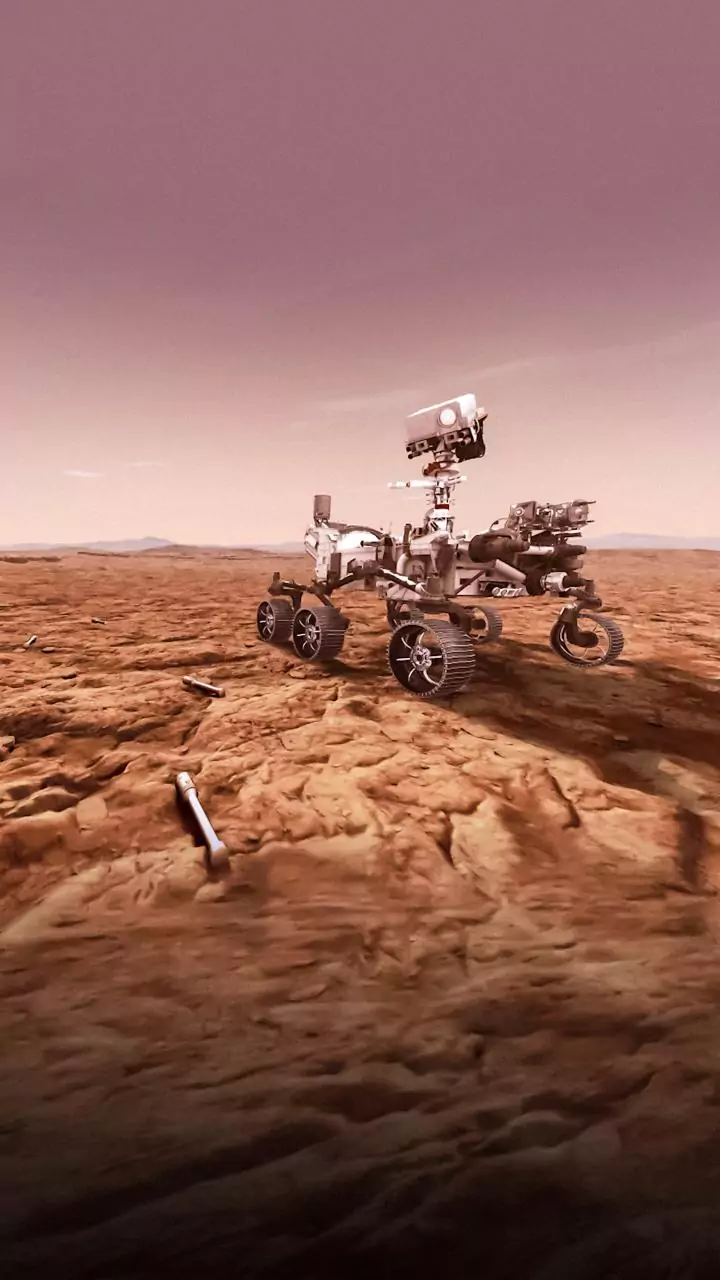
This isn't just a theory; we've seen it happen. NASA rovers, including Spirit, Opportunity, Curiosity, and Perseverance, have all captured stunning images of these blue-tinged sunsets over the years. These images, sent back from millions of miles away, confirm the physics at play and are used by scientists to study the composition and density of the Martian atmosphere. They serve as a beautiful reminder that the universe is full of familiar phenomena that manifest in alien ways, governed by the same fundamental laws of light and physics but with a completely different set of ingredients.