


Our Galaxy's Crooked Posture
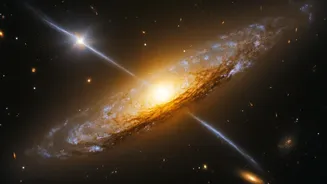
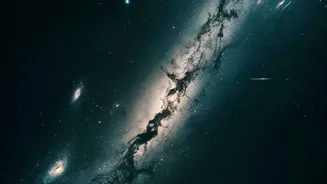
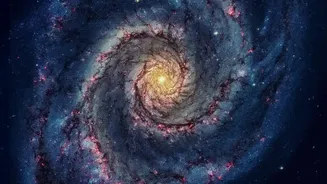
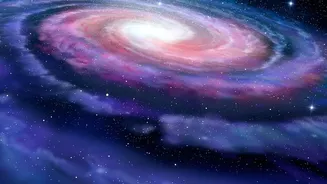
For decades, astronomers have been puzzled by the shape of the Milky Way. While its core is a bustling hub of stars arranged in a relatively flat disc, the outer edges are strangely distorted. Imagine a vinyl record left too long in the sun; it warps
and bends. Our galaxy's disc does something similar, with one side flaring up and the other down. Furthermore, the entire disc appears to be tilted within its vast, surrounding halo of stars and mysterious dark matter. For a long time, the reasons for this messy, lopsided structure were a profound cosmic mystery. A perfectly isolated galaxy should, over billions of years, settle into a neat, orderly plane. The fact that ours hasn't points to a dramatic external influence.
The Prime Suspect: A Galactic Smash-up
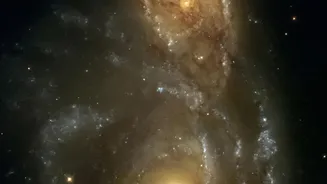
The leading theory for our galaxy’s peculiar shape is a history of violent collisions. Galaxies are not static islands in space; they move, interact, and often merge. These events aren't like car crashes with stars smashing into each other. Instead, the immense gravitational forces of the colliding galaxies tear each other apart, flinging stars and gas into new, chaotic orbits. Recent evidence, presented in July 2026 at the Royal Astronomical Society's National Astronomy Meeting, strongly suggests a massive, head-on collision is the culprit behind our galaxy's tilt. Using powerful supercomputer simulations, astronomers have shown that such an impact could have exerted enough force to completely reorient the Milky Way's disc.
Meet the 'Gaia Sausage'
The main perpetrator has a quirky name: the Gaia-Sausage-Enceladus (GSE) galaxy. This now-defunct dwarf galaxy slammed into a young Milky Way around 10 billion years ago. The 'Sausage' nickname comes from the elongated, sausage-like shape that its remnant stars now form as they orbit within our galaxy. Evidence for this ancient crash first came to light in 2018, thanks to data from the European Space Agency's Gaia space telescope, which is meticulously mapping the positions and movements of billions of stars. Scientists noticed a large group of stars moving in unusual, highly elongated orbits, a smoking gun for a cataclysmic merger that tore the smaller galaxy to shreds and scattered its contents throughout the Milky Way's halo.
A Flip, Not a Flop
The latest simulations from Durham University suggest the GSE collision was so powerful it caused the entire Milky Way disc to perform a dramatic "disc flip," tilting by more than 90 degrees over hundreds of millions of years. This event would have been like a gravitational uppercut, knocking the galaxy on its side. According to lead researcher Kirill Batrakov, this disc flip elegantly explains a related puzzle: why the vast stellar halo surrounding our disc rotates so slowly. The simulations showed that head-on collisions that cause disc flips are a common feature of galaxies with slow-spinning halos, just like ours. The immense gravitational torque from the merger gradually reoriented the disc, leaving it in the tilted position we observe today.
A Legacy Written in the Stars
This ancient collision didn't just give our galaxy its tilt. The merger was a defining moment in the Milky Way’s history, triggering massive bursts of star formation as the colliding gas clouds compressed. Many of the stars in the sparse halo, the central bulge, and even the thick disc we see today were either donated by the Gaia-Sausage galaxy or created in the fiery aftermath of its destruction. The event fundamentally reshaped our galaxy. Finding evidence that the entire disc flipped adds a dramatic new chapter to this story. It implies that the paths of all stars, possibly even our own Sun, were once very different, highlighting that our cosmic neighbourhood has been far from stable over its long life.