



A Bird Shrouded in Myth
The dodo, a flightless bird endemic to the island of Mauritius, was last seen in the late 17th century. Its rapid disappearance after the arrival of humans, combined with its trusting nature, cemented its reputation as foolish and inept—an image that
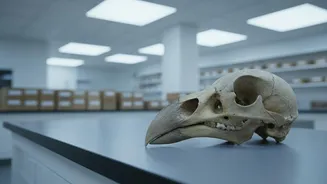
has persisted in popular culture for over 350 years. Because so few historical accounts were recorded while it was alive and no complete skins were preserved, scientists have been left with a frustratingly incomplete puzzle. Astonishingly, only two complete dodo skulls are known to exist in the entire world, housed in museums in Denmark and Oxford. This scarcity of remains has made understanding the dodo's true biology a monumental challenge.
Digital Dissection Through CT Scans
To solve these centuries-old mysteries without damaging the priceless skulls, an international team of researchers turned to high-resolution computed tomography (CT) scanning. This non-invasive technique, similar to medical CT scans, creates detailed 3D digital models of the skulls. While the dodo's soft brain tissue disappeared long ago, it left an imprint on the inner wall of the skull as it developed. By digitally reconstructing these cavities, known as endocasts, scientists can infer the size and shape of different brain regions. This process is like paleontological detective work, allowing researchers to piece together how the dodo may have sensed and interacted with its environment.
Smarter Than Its Reputation Suggests
One of the most significant findings directly challenges the 'dumb dodo' myth. When researchers examined the region of the brain associated with cognition and learning, they found it was proportional in size to that of modern pigeons—the dodo's closest living relatives. Since pigeons are known to be quite intelligent, with impressive problem-solving and navigational skills, there is no anatomical evidence to suggest the dodo was any less capable. Its infamous tameness was likely a result of evolving on an island with no natural predators, a common trait in such species, rather than a lack of intelligence.
A Surprising World of Senses
The scans revealed a sensory world very different from that of its relatives. The dodo had enlarged olfactory bulbs, suggesting a surprisingly well-developed sense of smell that it may have used to find fruit and other food. Furthermore, the nerve responsible for touch in the face was enlarged near its beak, indicating its large upper bill was a highly sensitive tool for exploring its surroundings. Perhaps most striking were the clues about its vision. While its eyes were large, the optic lobes—the brain regions that process visual information—were unusually small. This combination is often seen in nocturnal or crepuscular birds (active at dawn and dusk), hinting that the dodo may not have been strictly a daytime creature. This adaptation might have helped it avoid competition with other fruit-eating animals on Mauritius, like giant tortoises.
Rewriting an Extinction Story
These findings don't just give us a new picture of the dodo; they change how we think about extinction. The research shows the dodo wasn't a clumsy failure waiting to disappear but a unique species with a distinct combination of sensory adaptations developed over millions of years of isolated evolution. It was a creature finely tuned to its specific environment. The study underscores that its extinction was not a consequence of its own supposed inadequacies but a direct result of human impact, including overhunting and the introduction of invasive species. By moving beyond caricature and using evidence-based science, we gain a more accurate and respectful understanding of lost species.