





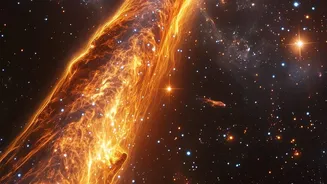
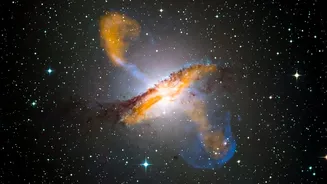
A Cosmic Engine in Miniature
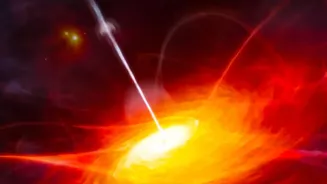
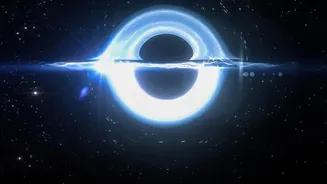
To understand a microblazar, first, we need to talk about its larger cousin: the blazar. Blazars are among the most energetic phenomena in the universe. They occur when a supermassive black hole at the center of a distant galaxy feeds on surrounding gas
and dust. This process unleashes colossal jets of particles and radiation that travel at nearly the speed of light. When one of these jets happens to be pointed directly at Earth, we call that object a blazar. For over 30 years, theorists predicted that a smaller version should exist — a 'microblazar' — powered not by a supermassive black hole, but by a much smaller stellar-mass black hole, just a few times the mass of our Sun, locked in a binary system with a companion star. IRAS 18293-0941, located about 12,000 light-years away, fits this description perfectly.
Hiding in Plain Sight
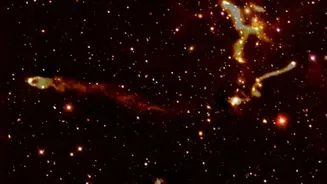
The object, IRAS 18293-0941, was first catalogued by the Infrared Astronomical Satellite back in 1983. However, for decades it remained just a point of light on a map, largely forgotten. Its location in the dense plane of the Milky Way meant it was hidden behind thick veils of interstellar dust, making it essentially invisible to optical telescopes. It wasn't until an international team of astronomers combined data from multiple powerful observatories — including the MeerKAT radio array in South Africa and the European VLBI Network — that its true nature began to emerge. They found a system where a black hole, about 10 times the mass of our sun, is orbiting a massive star every 11 days. The black hole strips material from its companion, and as that material spirals inwards, it powers two powerful jets. Crucially, radio observations confirmed one of these jets is pointed almost directly at us.
A Natural Particle Accelerator
The discovery is more than just confirming a long-held theory; it provides a 'cosmic laboratory' in our own galactic backyard. While the jet pointing towards Earth is what classifies it as a microblazar, it's the other jet, pointing away from us, that has scientists particularly excited. This second jet, which is harder to see directly, appears to be slamming into a dense cloud of interstellar gas about 100 light-years away. This collision creates a 'hotspot' that is thought to accelerate particles to incredible energies — potentially reaching petaelectronvolt (PeV) levels. To put that in perspective, this natural accelerator is about 100 times more powerful than the Large Hadron Collider on Earth. This could make systems like IRAS 18293-0941 a key source of the ultra-high-energy cosmic rays that constantly rain down on our planet.
The Neutrino Connection
This powerful particle acceleration also makes microblazars a prime suspect in the hunt for the origin of cosmic neutrinos. Neutrinos are mysterious, nearly massless 'ghost particles' that travel through the universe largely unimpeded. Pinpointing their sources is a major goal in modern astrophysics. For years, full-sized blazars have been considered the leading candidates for producing high-energy neutrinos. The discovery of IRAS 18293-0941 is significant because it's located very close to a known source of ultra-high-energy gamma-rays, which scientists believe could be created by the same processes that produce neutrinos. The connection suggests that this microblazar might be a source of these elusive particles, offering a nearby example to study how some of the universe's most extreme events unfold. Though the jet is pointed our way, scientists stress that at a distance of 12,000 light-years, it poses absolutely no danger to Earth.