




A River of Iron, Flowing Backward
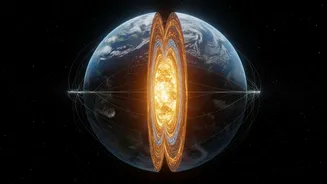
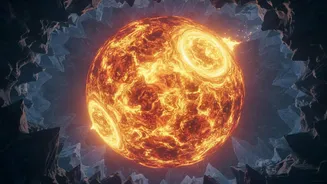
Our planet's core is not a simple, solid ball. It consists of a solid inner core and a liquid outer core, composed mainly of churning, superheated iron and nickel. For decades, scientists believed this vast ocean of liquid metal flowed in a generally
predictable westward direction, a motion that powers Earth’s protective magnetic field. But recent analysis of satellite data has revealed something startling. Around 2010, a huge section of this flow deep beneath the Pacific Ocean reversed course. What was once a weak westward drift suddenly became a strong eastward current. This was not a small eddy but a massive, regional change in the engine room of our planet, and scientists are still working to understand exactly why it happened.
The Mystery of the 'Why'
The term “unexplained” in science doesn't mean something is supernatural; it means our current models have a new puzzle to solve. The 2010 reversal beneath the Pacific is a perfect example. Scientists had previously thought of the core's circulation as being relatively stable over human timescales. This sudden shift suggests the deep Earth is far more dynamic and capable of rapid change than once believed. Some theories link this event to other deep-Earth phenomena observed around the same time, including a slight change in the rotation of the solid inner core and geomagnetic 'jerks'—abrupt glitches in the magnetic field. It's as if multiple parts of Earth’s inner machinery shifted at once, and researchers are now trying to determine if these events are connected.
The Pacific Anomaly: A Familiar Puzzle
While the 2010 reversal was a surprise, the idea that the core's flow isn't uniform is not entirely new. The 'Pacific Core-Flow Reversal' in the headline actually refers to a broader context. The region under the Pacific has long been known as an anomaly. While much of the outer core moves in a large, planet-circling gyre, the area under the equatorial Pacific seems to behave differently. This specific area is where the recent, dramatic eastward flow was detected. So, the context is that we were already aware of a uniquely behaving patch of the core; what’s new and “unexplained” is that this patch experienced such a sudden and significant change in direction on a timescale of just a few years.
Connecting the Core to the Crust
Events happening 3,000 kilometres below the surface might seem remote, but they have real-world implications. The flow of the outer core generates the Earth's magnetic field, a vital shield that protects all life from harmful solar radiation and makes modern navigation possible. Changes in this flow can influence the field's strength and shape. While the Pacific reversal poses no immediate danger, studying it helps scientists understand the long-term evolution of our planetary shield. These deep motions may also be linked to tiny, almost imperceptible changes in the length of a day, measured in milliseconds, as the core, mantle, and crust are all part of one interconnected rotating system.
Listening to the Planet's Heartbeat
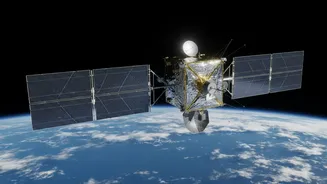
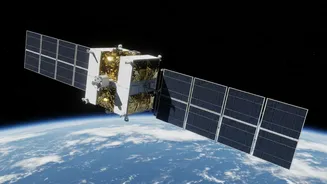
Scientists cannot drill to the core, so they act like planetary doctors, using indirect methods to diagnose what’s happening inside. They primarily use seismology—studying how waves from earthquakes travel through the planet—and precise measurements of the magnetic field from satellites like the European Space Agency's Swarm mission. By tracking changes in the magnetic field over years, they can infer the motion of the liquid iron that generates it. The recent discovery of the flow reversal was only possible because of decades of data collection from both the ground and space. Latest data suggests the eastward surge has already begun to weaken since 2020, adding another layer to the mystery. It leaves scientists wondering if this was a one-time event, part of a regular cycle, or the beginning of a new phase for our planet's core.