




Meet the Astronaut-Physician
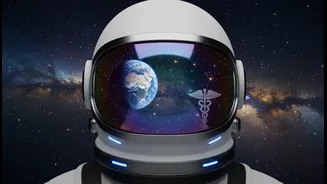
Dr. Anil Menon is not your typical astronaut. He is a US Space Force Colonel and an emergency medicine physician with a background that seems tailor-made for the challenges of space. Born in the US to an Indian father from Kerala and a Ukrainian mother,
Menon’s career has taken him from treating climbers on Mount Everest to serving on the front lines in Afghanistan. He was SpaceX’s first-ever flight surgeon, helping to create its medical program before being selected by NASA as an astronaut. His expertise in so-called “wilderness medicine”—providing care in extreme, resource-limited environments—is now being applied to the ultimate wilderness: deep space. Menon recently began an eight-month mission on the International Space Station (ISS), where his research portfolio is focused squarely on keeping humans healthy far from home.
The Tyranny of Distance in Space
On the ISS, astronauts are just a few hours away from returning to Earth in an emergency. But for future missions to the Moon or Mars, there is no quick trip back. A message sent from Mars can take over 20 minutes to reach Earth, making real-time medical guidance impossible. Furthermore, you can't pack a hospital. Every kilogram of cargo is precious, and medications have a limited shelf life, a problem that is exacerbated by space radiation. A simple cut, a broken bone, or a sudden illness could become a mission-ending catastrophe. Solving this requires a fundamental shift from carrying supplies to creating them on demand.
An Orbiting Pharmacy and First-Aid Kit
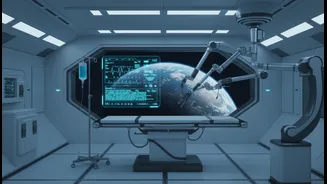
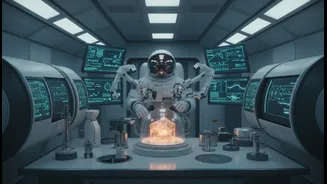
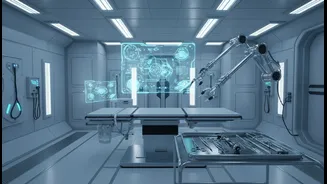
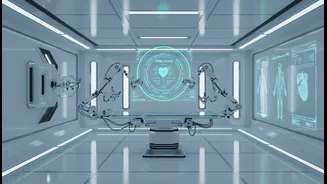
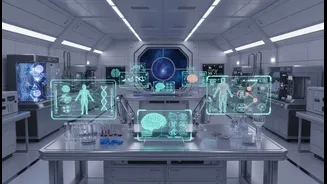
This is where Menon's work becomes critical. A key part of his mission involves testing technologies designed to make missions medically self-sufficient. One major experiment involves producing sterile intravenous (IV) fluids using the station's existing water supply. This could provide an endless source of IV bags for rehydration or delivering medication. Another area of his research is bioprinting. The ISS is home to the BioFabrication Facility (BFF), a 3D printer that uses living cells and biological materials, known as bio-inks, to create human tissue. While the ultimate goal is to one day print entire organs for transplant, the near-term applications Menon is testing, such as printing vascular constructs, could help create tissue for grafts or repairs in space.
Smarter Diagnostics, Less Reliance on Earth
Beyond manufacturing, Menon is also working on improving in-space diagnostics. He is testing an ultrasound system that uses augmented reality and artificial intelligence to guide non-medical astronauts through complex scans. This could eliminate the need for a doctor on Earth to interpret the results, a crucial step toward medical autonomy. He is also serving as a test subject himself, helping researchers study how microgravity affects blood flow and vein structure over long durations. Understanding these physiological changes is essential for developing effective countermeasures and protecting the health of future explorers on multi-year journeys.
Why It Matters for India and the Future
Menon’s work on the ISS is not just about NASA's ambitions to reach Mars. The technologies being developed have profound implications for healthcare on Earth, particularly in remote and underserved areas. More directly, this research provides a blueprint for India's own space aspirations. As ISRO prepares for the Gaganyaan mission and looks toward longer-duration flights, ensuring crew health and autonomy will be a top priority. Menon, who spent a year in India as a Rotary Scholar supporting polio vaccination efforts, embodies a bridge between a legacy of service and the future of exploration. His research aboard the ISS is a vital step in transforming humanity from Earth-bound visitors to space into a truly space-faring species.