




An Icon Forged In Speed
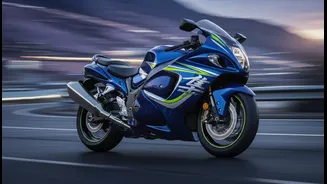
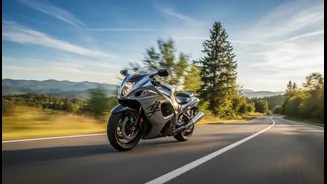
When Suzuki unleashed the GSX1300R Hayabusa in 1999, it wasn't just launching a new motorcycle; it was making a statement. The design brief was simple: create the world's fastest production motorcycle. Named after the Japanese word for Peregrine Falcon
— a bird that preys on blackbirds, in a direct nod to its rival, the Honda CBR1100XX Super Blackbird — the Hayabusa delivered. With a top speed soaring past 300 km/h, it immediately claimed the throne and ended the 'speed wars' of the 1990s, forcing manufacturers into an informal agreement to limit top speeds. This act alone cemented the Hayabusa's place in history, creating a legend defined by its groundbreaking aerodynamics and raw, untamed power.
The 'Dhoom' Bike of India
In India, the Hayabusa's fame transcended the riding community and roared into mainstream culture, largely thanks to its starring role in the 2004 Bollywood blockbuster 'Dhoom'. Suddenly, the 'Busa' wasn't just a hyperbike; it was the superbike, a symbol of ultimate speed and aspirational cool. This cinematic exposure made it a household name and an object of desire for a generation. Its muscular, aerodynamic silhouette became instantly recognizable on Indian roads, carrying a presence that no other motorcycle could match. This cult status is celebrated annually with 'Hayabusa Day' events across major Indian cities, bringing owners together and solidifying its unique position in the nation's biking culture.
More Than Just a Straight-Line Missile
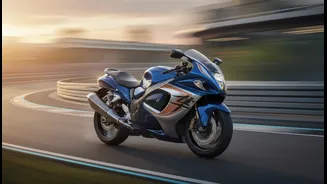
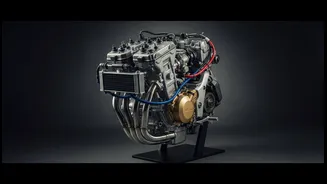
While its reputation was built on blistering acceleration, Suzuki's engineers knew that a true icon needed more than one trick. From its first generation, the Hayabusa was praised for its surprisingly capable handling and stability. The twin-spar aluminum frame provided a rigid and confidence-inspiring chassis, while the design focused on optimal balance and motion control. Reviewers noted that for all its power, the engine delivered torque smoothly across the rev range, making it predictable and user-friendly. This engineering focus ensured the Hayabusa was never a wild, unrideable beast; it was a powerful, yet composed, machine that could be ridden with precision, not just brute force.
The Gentle Giant for the Daily Commute
Here lies the Hayabusa's greatest paradox: a motorcycle built to exceed 300 km/h is remarkably comfortable and manageable in city traffic. Owners consistently praise its surprisingly relaxed ergonomics compared to track-focused superbikes. The seating position is sporty but not punishing, allowing for long-distance touring without fatigue. The latest generation takes this usability even further with a suite of advanced electronics called the Suzuki Intelligent Ride System (S.I.R.S.). This system includes adjustable power modes, allowing the rider to soften throttle response for urban environments. Features like cruise control, a bi-directional quick shifter, and low RPM assist make highway cruising and stop-and-go traffic effortless.
A Tamed Beast with a Button's Push
The secret to the Hayabusa's dual personality is its advanced technology. The third-generation model, launched in 2021, is a masterpiece of electronic refinement. The Suzuki Drive Mode Selector Alpha (SDMS-α) allows riders to choose from preset or custom modes that alter power delivery, traction control, anti-lift control, and engine braking. In its mildest setting, the engine is docile and forgiving, perfect for a wet commute. With a few button pushes, it can transform back into the sharp, full-power beast of legend. This adaptability is what makes it so unique. It’s a hyperbike that doesn’t demand you ride it at full throttle, proving to be just as happy cruising at 50 km/h in top gear as it is chasing horizons.