

The Reigning Champion: A Giant Impact
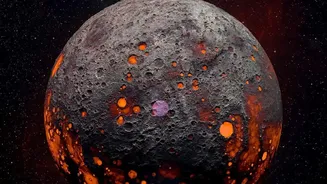
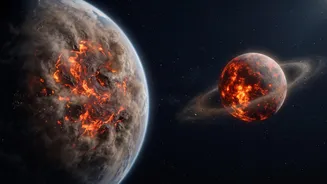
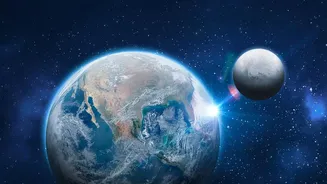
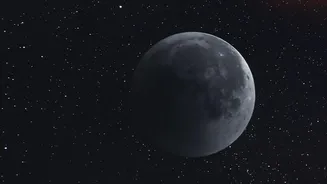
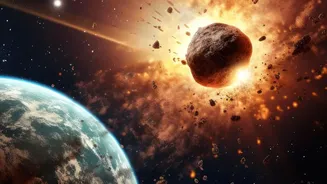
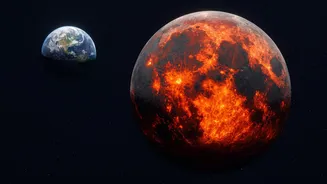
For decades, the leading explanation for the Moon's existence has been the "giant-impact hypothesis". The story goes that about 4.5 billion years ago, when our solar system was a chaotic construction zone, a Mars-sized planet named Theia slammed into
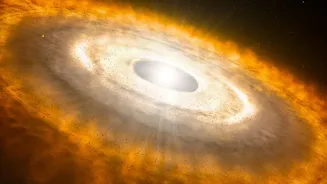
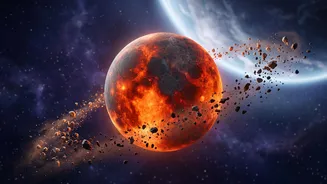
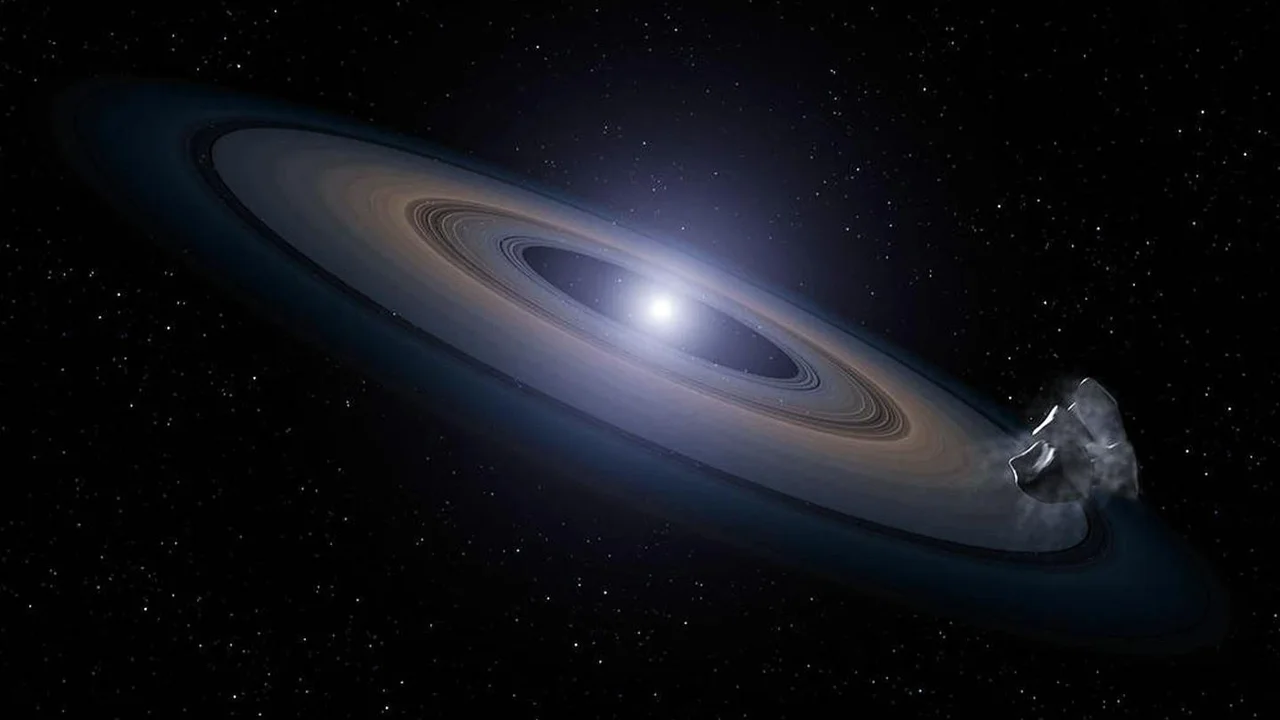
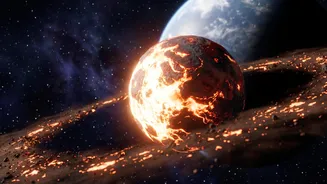
the still-forming Earth. The cataclysmic collision was thought to have vaporized huge portions of both worlds, blasting a massive cloud of molten rock and debris into orbit. According to this model, this material then formed a wide, flat ring around Earth—a debris disk. Over thousands or even millions of years, gravity caused this debris to slowly clump together, eventually accreting into the Moon we see today. This narrative explained many key features, such as the Moon's size, orbit, and why it has a much smaller iron core than Earth.
Cracks in the Classic Story
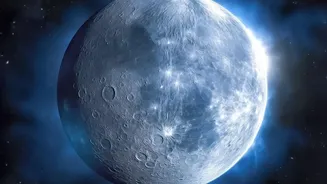
Despite its success, the debris-disk model has struggled to explain one crucial detail. Analysis of the lunar rocks brought back by the Apollo missions revealed a startling fact: the Moon and Earth are chemical twins. Their isotopic signatures are almost identical, suggesting they are made of the same source material. This is a problem for the classic giant-impact theory. If the Moon formed mostly from the debris of Theia, it should have a distinct chemical fingerprint from its parent planet. For the Moon to be so Earth-like, the collision would have had to mix the material from both planets with almost perfect efficiency, a scenario that many simulations suggest is highly unlikely. This isotopic crisis has sent scientists searching for alternative scenarios that could better explain this fundamental similarity.
A Faster, More Furious Beginning
Recent work has presented a dramatic alternative that sidesteps the long, slow accretion from a debris disk. Instead of forming a stable ring, new high-resolution computer simulations show the Moon could have formed almost immediately after the impact—in a matter of hours. These models, conducted by researchers at institutions like NASA and Durham University, suggest that the collision could have launched a large, Moon-sized chunk of material directly into orbit. This proto-Moon would have been a hot, molten body that then settled into the satellite we know today, eliminating the need for a long-lived debris disk. This “immediate formation” model provides a more elegant solution to the chemical twin problem, as the Moon would be formed from a well-mixed blend of Earth and Theia material from the moment of impact.
Meet the Synestia: A Planetary Donut
Another related idea that challenges the simple debris-disk model is the concept of a "synestia". Coined by researchers Sarah Stewart and Simon Lock, a synestia is a new type of planetary object: a huge, rapidly spinning, donut-shaped cloud of vaporized rock. This structure would have been created by the sheer energy of the giant impact. Instead of a tidy disk, the collision would have formed a single, massive, puffed-out body with the young Earth at its center. The Moon would then have formed inside this vaporized Earth, condensing from the hot silicate rain at temperatures over 2,000°C. This model also neatly explains the Earth-Moon isotopic similarities, as the Moon would have been born from the same vapor cloud as the condensed Earth. It also explains why the Moon is depleted in more volatile elements; they simply couldn't condense in such an extreme environment.