






What is V2V Communication?
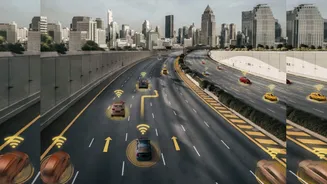
Vehicle-to-Vehicle, or V2V, communication is a wireless technology that allows cars, trucks, and even two-wheelers to 'talk' to each other in real-time. Using dedicated short-range radio signals, vehicles can continuously broadcast and receive information
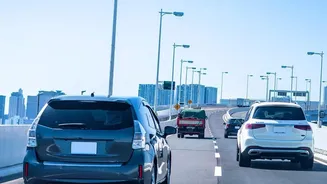
about their speed, position, direction, and braking status up to ten times per second. Unlike Advanced Driver Assistance Systems (ADAS), which rely on cameras and sensors limited by line-of-sight, V2V can 'see' through other vehicles and around corners. This creates a 360-degree awareness bubble, warning drivers of hazards long before they become visible.
Beyond Alerts: Adding Critical Context
Standard hazard warnings are helpful, but V2V adds a crucial layer of context. Instead of a generic "slowdown ahead" alert, the system can provide specific, actionable intelligence. For instance, it can differentiate between a car that is merely slowing down and one that has slammed on its brakes in an emergency. The technology enables specific warnings for forward collisions, unsafe lane changes, wrong-way drivers, and approaching emergency vehicles. If a truck several vehicles ahead brakes suddenly, your car would receive an 'Emergency Electronic Brake Light' warning, giving you vital seconds to react, even if your view is completely blocked. This contextual information transforms a simple warning into a precise safety tool.
India's Decisive Push for Connected Cars
The most significant recent update is a draft notification from India's Ministry of Road Transport and Highways (MoRTH) issued in August 2026. It proposes making V2V communication systems mandatory for all new vehicles manufactured from October 1, 2028. This includes two-wheelers (Category L), passenger vehicles (Category M), and commercial goods vehicles (Category N). A phased rollout is planned, with systems installed voluntarily from October 1, 2027, required to comply with the new Automotive Industry Standard (AIS-230). This move was enabled by a June 2026 decision from the Department of Telecommunications to de-license the 5.9 GHz frequency band, clearing a key regulatory hurdle for V2V implementation.
The Technology and the Roadmap
The Indian standard, AIS-230, specifies the use of Cellular Vehicle-to-Everything (C-V2X) technology. This allows vehicles to communicate directly with each other (V2V) and sets the stage for future communication with infrastructure like traffic lights (V2I), pedestrians (V2P), and the broader network (V2N). The government's decision to mandate V2V first is a strategic one; it allows for the deployment of crucial safety applications without waiting for smart city infrastructure to be fully built out. This phased approach gives manufacturers and suppliers time to adapt to the new regulations and build a robust ecosystem around the technology.
Challenges on the Road Ahead
Despite the clear roadmap, significant challenges remain. A primary hurdle is the transition period, where a small number of V2V-equipped vehicles will share the road with millions of non-connected ones, limiting the network's effectiveness in the early years. Widespread infrastructure for a full V2X ecosystem, including smart traffic signals, is still lacking in India. Furthermore, ensuring the system is secure from hacking and spoofing is critical, as a compromised system could create false warnings and be more dangerous than no system at all. There are also concerns about making the technology affordable and inclusive, ensuring its safety benefits extend beyond premium cars to two-wheelers and pedestrians.