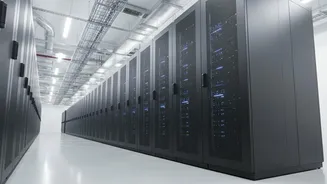









The Engine Room of AI
For years, OpenAI has relied heavily on its close partner, Microsoft, to power its world-changing AI models. The partnership, initiated in 2019, gave OpenAI access to Microsoft's massive Azure cloud platform, a supercomputing ecosystem essential for training
and running its technologies. This symbiotic relationship allowed OpenAI to scale rapidly without having to build its own physical infrastructure from the ground up. Microsoft provided the digital landlord service, and OpenAI was the star tenant, pushing the boundaries of what was possible within those rented walls. However, the sheer success and exponential growth of models like GPT-4 and beyond have created a new problem: an almost infinite appetite for computing power.
An Insatiable Appetite for Power
Training a frontier AI model is one of the most expensive and energy-intensive tasks in the modern world. Costs can run into hundreds of millions of dollars for a single training run, driven primarily by the need for thousands of specialized GPU chips running for months. But the cost is not just financial. These data centres consume staggering amounts of electricity, with some large-scale AI campuses requiring power equivalent to a small city. As OpenAI plans for even more advanced models, it faces a critical bottleneck. Relying solely on rented capacity from a single provider creates risk. What happens if that capacity is constrained, or if costs spiral out of control? To secure its future, OpenAI has realised it can no longer just be a tenant; it needs to have a say in how the building is designed and built.
From Renter to Architect
Seeking "more control" is OpenAI's strategic shift from simply consuming cloud services to actively shaping its infrastructure supply chain. This doesn't necessarily mean building every data centre itself from scratch, though the company is now directly involved in designing and developing new sites, like its 'Project Camellia' in Georgia. The strategy is multi-faceted. It involves diversifying its partners beyond an exclusive reliance on Microsoft, with major infrastructure deals now in place with companies like Oracle. It means co-designing facilities that are optimized for AI workloads from the foundation up, focusing on power availability first and foremost. Recent reports even suggest OpenAI is exploring deeper involvement in hardware, from securing financing for chip purchases to developing its own intellectual property for data centre design. It's about treating computational power not as a utility to be rented, but as a core strategic asset to be controlled.
The Ripple Effects
This strategic pivot has significant implications for the entire tech industry. For Microsoft, the relationship is evolving from exclusive to 'Azure-first,' a more flexible but less rigid arrangement. For the data centre market, it's fueling a boom in massive, gigawatt-scale campuses designed specifically for AI. The move also signals a maturation of the AI industry. The race is no longer just about having the smartest algorithms, but also about securing the physical resources—power, land, and hardware—to run them. This infrastructure arms race is forcing a long-term view, with companies now making plans and investments that stretch out a decade or more. By taking a more direct hand in its data centre capacity, OpenAI is making a high-stakes bet that controlling the physical engine of AI is the only way to guarantee its leadership in the digital future.