




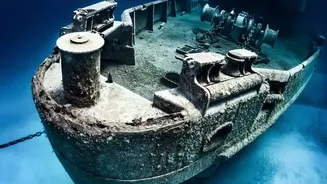

A 'Time Capsule' on the Seabed
A team led by Hakan Öniz, an underwater archaeologist from Akdeniz University, made the stunning find near Kekova Island in Antalya, a region known for its turbulent waters that have claimed ships for centuries. While the vessel’s wooden hull, estimated
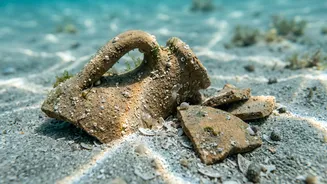
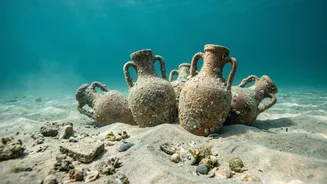
to have been about 10 metres long, disintegrated long ago, its cargo remains as a ghostly outline of the ship's final moments. More than 30 ceramic storage jars, known as amphorae, and three large stone anchors were found scattered across an underwater slope. This collection of artefacts provides a rare and invaluable snapshot of maritime life during the Early Bronze Age, a period that coincided with the construction of the Great Pyramids in Egypt.
Dating the Past with Pottery
Without any timber to radiocarbon date, researchers turned to the cargo itself for answers. The age of the shipwreck was determined by the distinctive style of the amphorae—two-handled jars with a flat base and a ridge around the middle. This design is a perfect match for pottery known to have been produced between 4,400 and 4,700 years ago in regions of the Middle East, including the Jordan Valley. When the team first located the site in 2022, they initially thought the jars might be only a few hundred years old, but a comparison with pottery found near Egypt's Giza pyramids revealed their true, breathtaking age. This discovery surpasses the previous record-holder for the oldest shipwreck, a 4,200-year-old vessel found off the coast of Greece.
Rewriting Ancient Trade Routes
This isn't just an old wreck; it’s a crucial piece of evidence that redraws our understanding of ancient commerce. The find provides rare physical proof of extensive and organised maritime trade networks connecting the Levant (modern-day Syria, Lebanon, and Israel), Anatolia, the Aegean, and Egypt during the third millennium BC. Clay analysis suggests the jars were made in the Jordan Valley and were likely filled with commodities like olive oil or wine. Researchers believe the ship departed from a port in the eastern Mediterranean and was sailing west, possibly towards Troy or the island of Crete, when it sank. The discovery fills a significant gap in the story of how goods, ideas, and cultures were already moving across vast distances by sea nearly 5,000 years ago.
Life Aboard a Bronze Age Ship
Remarkably, some of the sealed amphorae still contain residue of their ancient contents, giving scientists a direct look at the goods being transported. Analysis is underway to determine exactly what the ship was carrying, which could be anything from wine and olive oil to valuable tree resins. One particularly fascinating find is a unique jar with two holes in its side, which has led to a theory that it may have been a churn. This raises the tantalising possibility that sailors kept live goats on board to make their own butter or cheese during long voyages, offering a personal glimpse into the daily lives of these ancient mariners.
What Happens Next?
The excavation and conservation process is a delicate one. The recovered amphorae are being carefully preserved at a regional laboratory, where experts are studying them. Turkey’s Minister of Culture and Tourism, Mehmet Nuri Ersoy, has announced that the incredible finds will eventually be displayed for the public at a new Mediterranean Underwater Archaeology Museum planned for the area. The ongoing investigation of the wreck site promises to yield even more information, deepening our understanding of this pivotal era in human history and reminding us that the sea floor still holds countless secrets.