



The Hunt for 'Goldilocks' Worlds
The search for extraterrestrial life has long focused on finding 'Goldilocks' planets: worlds that are not too hot and not too cold for liquid water to exist on their surface. This region around a star is called the 'habitable zone'. For a planet to be
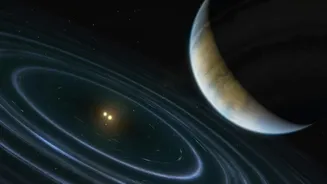
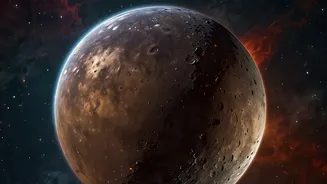
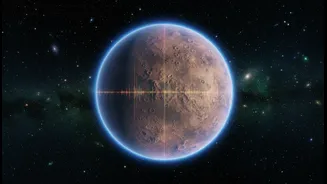
a true contender for hosting life as we know it, it also needs to be rocky, like Earth, rather than a gas giant like Jupiter. Until recently, finding such planets was the primary goal. We could spot them, measure their size, and calculate their orbits, but understanding what they were truly like remained a matter of theory and speculation. A recent breakthrough has changed everything. For the first time, astronomers have confirmed an atmosphere around a rocky planet within its star's habitable zone. The planet, a 'super-Earth' named LHS 1140 b, is about 48 light-years away and has become a prime target in the quest for habitable worlds.
From Shadows to Chemical Fingerprints
Previously, our main tool for studying exoplanets was the 'transit method'. This involves watching for the tiny dip in a star's light as a planet passes in front of it. While effective for detection, it offers limited information. The new frontier is atmospheric measurement, specifically a technique called transmission spectroscopy. When a planet transits its star, a small fraction of the starlight filters through the planet's atmosphere. By capturing this light with powerful telescopes, scientists can analyse its spectrum. Different gases in the atmosphere absorb specific wavelengths of light, leaving behind a unique chemical 'fingerprint'. This allows astronomers to identify molecules like water vapour, methane, carbon dioxide, and oxygen—the building blocks and byproducts of life.
The Telescopes That Opened a New Window
This incredible new capability is largely thanks to the James Webb Space Telescope (JWST). Launched with the promise of revolutionising astronomy, it is now delivering on that promise by providing unprecedented detail on exoplanet atmospheres. Its advanced spectrographs can detect faint signals from trace gases that were previously impossible to see. While JWST leads the charge, ground-based observatories are also playing a crucial role. Instruments like the WINERED spectrograph in Chile, which was used to detect helium escaping from LHS 1140 b's atmosphere, are proving that Earth-based telescopes can make significant contributions. New techniques are allowing ground-based observations to achieve precision that rivals space telescopes, making atmospheric studies more accessible.
The Search for Biosignatures
Detecting an atmosphere is the first step; the next is to search it for 'biosignatures'. These are gases or combinations of gases that are strong indicators of biological processes. On Earth, the presence of abundant oxygen is a direct result of life (photosynthesis), making it a primary target in the search on other worlds. Methane is another key biosignature. While it can be produced by geological activity, its presence alongside oxygen and water vapour would be highly suggestive of life. The goal is to look for a chemical imbalance—a mix of gases that shouldn't exist together without a constant source, like a planet-wide ecosystem, replenishing them. Scientists are now moving from simply looking for the right conditions for life to actively searching for its chemical evidence.
A New Chapter in Cosmic Exploration
The ability to measure the atmosphere of a rocky, habitable-zone planet marks a monumental shift. It moves the entire field from a discipline of discovery to one of characterisation. We are no longer just counting planets; we are beginning to understand them as individual worlds with their own chemistry and climate. The discovery on LHS 1140 b is not an endpoint but a starting point. This technique can now be applied to dozens of other promising rocky worlds that have been catalogued. It transforms the search for aliens from a passive hunt into an active investigation. Each new atmospheric measurement will help us understand the diversity of planets in our galaxy and refine our models of which ones are most likely to harbour life.