








A 'Cab Service' to Space
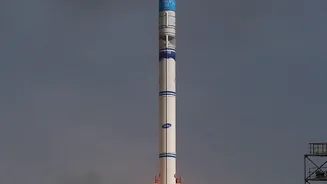
The successful launch of Vikram-1 from the Satish Dhawan Space Centre in Sriharikota represents a pivotal moment for India's ambitions in the global space economy. Developed by Hyderabad-based startup Skyroot Aerospace, Vikram-1 is the country's first
privately developed orbital rocket. Its flawless flight, placing multiple payloads into low-Earth orbit, makes India only the third country, after the US and China, with private launch capability. The achievement is not just a technical triumph but a strategic one. While ISRO operates large-scale launch vehicles akin to a state-run railway service, Skyroot aims to offer something different: a private 'cab service' to space. The Vikram-1 is designed for the burgeoning small satellite market, promising dedicated, on-demand launches that are faster and more flexible than traditional rideshare missions on larger rockets. This capability serves a massive underserved segment and provides India with sovereign 'surge capacity'—the ability to launch satellites quickly without relying solely on ISRO, a crucial asset for both commercial and national security interests.
The Visionary's Audacious Bet
Long before Skyroot became India's first space-tech unicorn, it was a bold idea pitched via a LinkedIn message. In 2018, former ISRO scientists Pawan Kumar Chandana and Naga Bharath Daka reached out to Mukesh Bansal, the celebrated founder of Myntra and Cult.fit, with a plan to build rockets privately. At the time, India's space sector was not yet formally open to private enterprise, making the venture seem more like science fiction than a sound investment. Yet, Bansal, known for his success in consumer internet, saw the potential. He made an initial angel investment of ₹10 crore, becoming the company's first and, for nearly two years, only outside backer. This was a significant departure from his usual investment thesis, a bet on deep-tech in a highly regulated and unproven market. His faith was crucial; when the COVID-19 pandemic tightened funds, he invested another ₹2 crore to ensure the team could stay together. That early belief has paid off spectacularly. Bansal's total investment of around ₹12 crore has reportedly yielded a return of nearly 60 times, with his remaining stake valued at over ₹600 crore.
The Architects of the Dream
The success of Vikram-1 is a testament to the vision of its founders, Pawan Kumar Chandana and Naga Bharath Daka. Both were accomplished scientists at the Indian Space Research Organisation (ISRO), working on prestigious national projects like the LVM3 'Bahubali' rocket. In 2018, inspired by the prospect of policy changes that would open the space sector, they left their secure government jobs to found Skyroot Aerospace in Hyderabad. Their mission was ambitious: to democratise space access by making it affordable and reliable. They combined ISRO's deep institutional knowledge with startup agility, leveraging cutting-edge technologies like all-carbon composite structures and fully 3D-printed engines to reduce production time and costs. This innovative approach allowed Skyroot to move from a suborbital test rocket, Vikram-S in 2022, to the orbital-class Vikram-1 just a few years later, demonstrating a rapid development cycle that is key to competing in the fast-paced commercial space race.
A New Space Race Fueled by Policy
Skyroot's milestone was made possible by a systemic shift in India's space policy. Beginning in 2020, the government began a series of reforms to deregulate the sector and encourage private participation. The establishment of the Indian National Space Promotion and Authorization Center (IN-SPACe) was a game-changer. IN-SPACe acts as a single-window regulatory body, streamlining approvals and giving private companies access to ISRO's invaluable facilities, from launchpads to testing sites and technical expertise. This public-private partnership model has allowed the number of Indian space startups to grow from just one in 2014 to over 400 today. The goal is to grow India's share of the global space economy from its current 2-3% to 8% by 2033. Vikram-1's launch is the most powerful proof yet that this policy is working, transforming the sector from a government monopoly to a dynamic ecosystem of multiple innovators.