




An Unlikely Refuge
The lunar surface is one of the most hostile environments imaginable. With no atmosphere to speak of, it is blasted by intense, unfiltered ultraviolet (UV) radiation from the Sun. Temperatures swing wildly, from a scorching 127 degrees Celsius in the day
to a frigid -173 degrees Celsius at night. Previous studies concluded that these conditions, especially in the equatorial regions visited by the Apollo missions, would make survival for any Earth-based life form virtually impossible. However, a new study led by NASA scientists challenges this long-held assumption by looking at a different, and much more talked-about, location: the lunar south pole.
A Shadow of a Chance
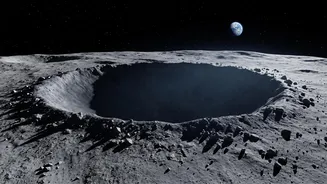
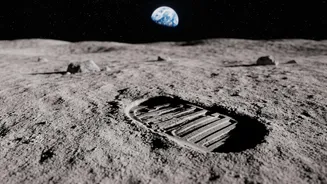
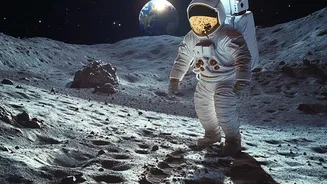
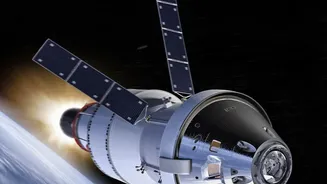
Future crewed missions, including NASA’s Artemis program, are targeting the Moon’s south pole because of the presence of water ice in permanently shadowed regions (PSRs). In these craters, which sunlight never reaches, temperatures are consistently low enough to preserve ice. The new research, published in Science Advances, used models to show that these PSRs aren't the only places offering protection. Because the sun is always low on the horizon at the poles, even very small topographical features cast long shadows. These shadows create tiny micro-environments shielded from the worst of the UV radiation. According to Prabal Saxena, a planetary scientist at NASA’s Goddard Space Flight Center, “Even a bootprint or a rover's tread may create a habitable area.” These small indentations could offer just enough shade to allow some of the hardiest microbes to survive.
Earth's Toughest Stowaways
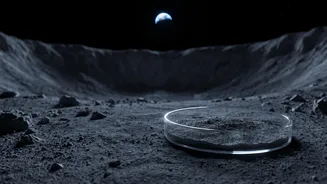
Humans are veritable clouds of microorganisms; we carry millions of bacteria on every small patch of our skin. It is inevitable that when astronauts explore the Moon, they will leave some of these microbes behind, vented from spacesuits or shed with skin cells. The NASA study modelled the survival chances for five common microbes known to be resilient in spaceflight environments, including species found on the International Space Station. The results showed that while most would perish, some could survive, entering a dormant state called cryptobiosis where they don't grow or reproduce but simply endure. The most resilient of the group was a fungus called Aspergillus niger, commonly known as black mould. Its toughness against UV radiation and other harsh conditions means it could potentially survive for up to a week in these tiny shadowed niches.
A Planetary Protection Puzzle
The findings present a fascinating puzzle for planetary protection—the practice of preventing biological contamination between Earth and other celestial bodies. For decades, the Moon was considered a low-risk environment, essentially sterile. This new understanding that Earth microbes could survive, particularly in the polar regions where future bases are planned, changes the calculus. Scientists are concerned that this contamination could interfere with the search for the Moon's own ancient chemistry, potentially obscuring clues about the early solar system. Heather Graham, a study co-author from NASA, notes that this means we need to be more thoughtful about what we unintentionally bring with us. Every landing and every footstep complicates our ability to distinguish between terrestrial contamination and any potential native lunar biology or chemistry.
The Moon as a Natural Laboratory
While the risk of contamination is a serious concern, the study’s authors also see an opportunity. The Moon could serve as a unique natural laboratory to test the absolute limits of microbial survival in an environment that cannot be replicated on Earth. By carefully studying the microbes that we inevitably introduce, scientists can gain invaluable data on how life adapts to extreme space conditions. This has direct implications not only for future lunar habitats but also for the even more ambitious goal of sending humans to Mars. The Artemis missions, poised to be the first to explore the lunar south pole with humans, will now have an additional, and crucial, scientific objective: to understand the tiny, unintended ecosystem humanity is creating with every footprint left in the lunar dust.