
A Full-Body Conversation
Anyone who has tried a West African dance class knows the feeling: a full-body workout that leaves you breathless but invigorated. The movements are often grounded, using the entire body to generate power and expression. But this physical intensity is merely
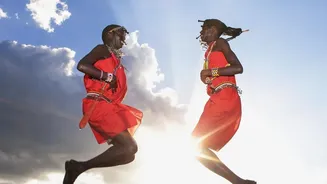
the entry point. In many African traditions, dance is not simply exercise; it is a form of communication, a living library of stories, histories, and cultural values. Every gesture has a purpose, from celebrating a harvest to marking a rite of passage or honouring ancestors. This transforms the act of dancing from a personal fitness goal into a participatory dialogue with a culture and a community.
The Mental Marathon of Polyrhythm
Here is where the challenge moves from your legs to your brain. A core feature of many African musical traditions is polyrhythm—the layering of multiple, distinct rhythms played simultaneously. For the dancer, this is a profound cognitive exercise. You aren't just stepping to a single beat. Instead, your body must become an orchestra. As one expert described the experience, your feet might follow the gongs, your hips move with one drum, and your shoulders and back align with a second drum. This requires immense concentration and mental flexibility, forcing the brain to process and embody several patterns at once, enhancing cognitive function, memory, and focus.
Thinking with Your Whole Body
Complementing polyrhythm is the concept of polycentrism. This is the idea that movement can originate from any part of the body, with multiple centers of motion active at the same time. A dancer's head, torso, and hips might all move independently yet harmoniously, each following a different rhythmic logic. This approach creates a complex, articulated, and fluid style of movement that contrasts sharply with many Western dance forms that prioritize a single core and linear movements. Mastering polycentrism requires a deep mind-body connection, challenging the dancer to think with their entire body and not just execute steps.
More Than Movement, It's Meaning
Across the continent, dance serves vital social and spiritual functions. It is used in rituals to connect with the divine, to tell the history of a people, or to offer social commentary. The Yoruba of Nigeria, for example, use specific dances to honour different Orishas, or divine entities, with each having unique rhythms and movements. In Ghana, the Agbadza dance helps unite the Ewe people, reinforcing a common identity across modern national borders. To participate in these dances is to embody and preserve this knowledge, making the dancer a steward of cultural heritage. This adds a layer of intellectual and emotional engagement far beyond what is required in a typical fitness class.
The Challenge of Community
Finally, traditional African dance challenges the modern, individualistic approach to exercise. It is fundamentally a communal activity. These dances are not performances for a passive audience but participatory events that bring everyone—elders, youth, men, and women—into a shared experience through movement, song, and rhythm. This collective energy fosters social cohesion, emotional release, and a powerful sense of belonging. In a world where many feel isolated, the challenge to move in sync with a group, to share a rhythm, and to create something together is perhaps the most profound and rewarding one of all.