





The Ultimate Deep Freeze
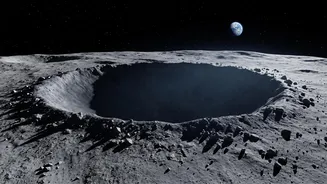
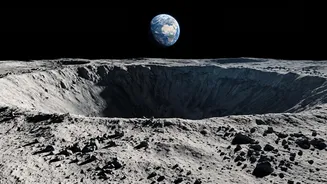
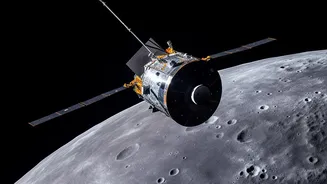
At the Moon’s south pole, the sun hangs perpetually low on the horizon. Because the Moon has almost no axial tilt, the floors of some deep craters have not seen a single ray of sunlight in billions of years. These areas are known as permanently shadowed
regions (PSRs) or, more simply, “cold traps.” They are some of the most frigid places in our entire solar system, with temperatures plunging low enough to freeze not just water but also gases like carbon dioxide. Without an atmosphere to circulate heat, these craters act like perfect, natural freezers, preserving a pristine record of anything that happens to fall in.
Earth's Toughest Hitchhikers
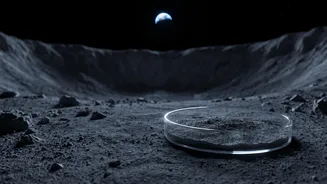
Humans are walking, talking ecosystems. On average, a million bacteria live on a patch of skin the size of a pencil eraser. Wherever we go, we shed these microscopic companions. For years, it was assumed the Moon's harsh environment — a vacuum blasted by extreme temperatures and unfiltered ultraviolet (UV) radiation — was a death sentence for any such life. But recent studies led by NASA scientists challenge this idea. Using models based on data from orbiters, they simulated conditions at the south pole and found that certain hardy microbes could survive. These aren't just exotic “extremophiles”; they include common species found in spacecraft and on human skin, such as Aspergillus niger (a type of black mold) and Staphylococcus aureus.
How Survival Is Possible
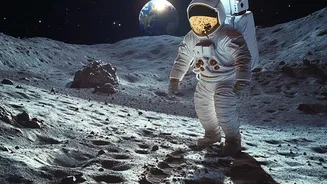
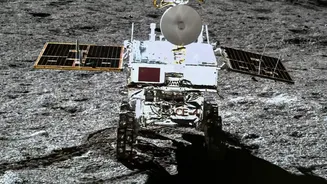
The key is shelter. While most of the lunar surface is sterilized by UV radiation and heat, the topography of the polar regions offers protection. The perpetual shadows in craters are the most obvious refuge, blocking deadly radiation and keeping things cold. But survival niches could be much smaller. A new study revealed that even a simple astronaut bootprint or a rover's tread mark could create a tiny patch of shadow sufficient for microbes to persist. The models showed that some fungi, like Aspergillus, are particularly resilient to UV radiation and could survive for days or weeks even in areas with some indirect sunlight. While these microbes wouldn't be able to grow or reproduce, they could enter a dormant, suspended state, waiting for conditions that may never come.
A Planetary Protection Dilemma
This possibility creates a major headache for scientists and mission planners. A primary goal of exploring the Moon is to study its pristine geology and search for clues about the early solar system, including ancient organic chemistry. If we contaminate these sites with our own microbes, it becomes incredibly difficult to tell if any organic molecules we find are truly lunar or just contamination from Earth. This has led to calls for stricter “planetary protection” protocols. Historically, the Moon was considered low-risk. But the discovery of water ice and now the potential for microbial survival in polar regions has prompted updates, with special designations for missions heading to these scientifically sensitive areas.
The Way Forward for Artemis and Beyond
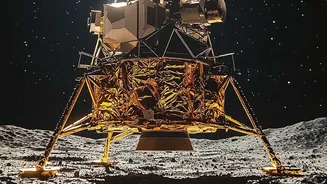
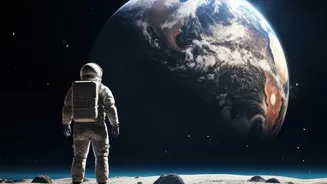
With NASA's Artemis program aiming to land astronauts at the south pole, this is no longer a theoretical problem. The very regions targeted for human exploration due to their resources, like water ice, are the same ones that could be contaminated. According to NASA planetary scientist Prabal Saxena, bringing microbes is unavoidable. The challenge, therefore, is to turn this into a useful experiment. By carefully tracking what we bring with us, scientists can distinguish between earthly contamination and native lunar chemistry. Some researchers even argue the Moon could serve as a natural laboratory to test the absolute limits of microbial survival in an environment that can't be perfectly replicated on Earth. The goal is to explore responsibly, ensuring our search for knowledge doesn't accidentally erase the very clues we are looking for.