


A Predictable Universe, Mostly
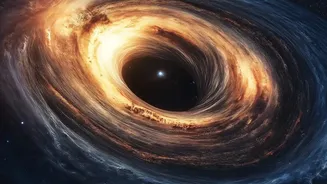
For decades, our picture of a galaxy has been fairly consistent. At the heart of nearly every large galaxy, including our own Milky Way, lurks a supermassive black hole. These cosmic titans, millions or even billions of times the mass of our Sun, act
as gravitational anchors. Everything in the galaxy, in a sense, revolves around them. We assume they are the fixed, immovable centerpieces of their cosmic cities. This fundamental assumption helps astronomers model how galaxies form, grow, and evolve. Because these behemoths are usually dormant and don't emit light, they are incredibly difficult to see directly. Scientists typically find them by observing their powerful gravitational effects on nearby stars or by spotting the brilliant flare of energy when they devour gas and dust. This standard model has been incredibly successful, but the universe often has surprises in store.
Swift's Surprising Discovery
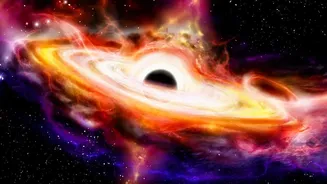
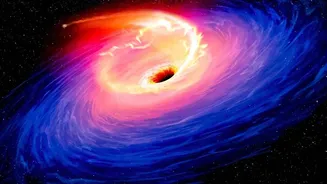
Recently, NASA's Neil Gehrels Swift Observatory, a satellite designed to detect high-energy bursts from cosmic events, spotted something truly unusual. It saw a massive flare of light from a distant galaxy, about 750 million light-years from Earth. This kind of flare often signals a tidal disruption event (TDE), which occurs when a star wanders too close to a black hole and is violently ripped apart by its gravity. But this TDE wasn't happening in the galactic core. Instead, it was blazing from the galaxy's outskirts, more than 30,000 light-years from the center. This event briefly outshone its entire host galaxy, revealing the culprit: a previously invisible, wandering supermassive black hole with about a million times the mass of our Sun. It was an 'orphan' black hole, far from its expected home.
The Cosmic Slingshot Hypothesis
So, how does a supermassive black hole end up lost in the galactic suburbs? This is the central scientific question that has astronomers buzzing. The leading theory involves the chaotic dance of galaxy mergers. Galaxies are not static; they often collide and merge over billions of years. When two galaxies, each with its own central black hole, crash into each other, their respective black holes will begin to orbit one another. As the merger progresses, a complex gravitational tug-of-war can ensue. According to theoretical models, it’s possible for one of the black holes—usually the lighter one—to be flung out of the newly formed galactic center in a slingshot effect. This can send the black hole careening into the galaxy's outer halo, destined to wander alone for eons.
A Devoured Galaxy's Ghost
Another compelling possibility is that we are witnessing the ghost of a devoured galaxy. In this scenario, a large galaxy like the one observed may have cannibalized a much smaller, dwarf galaxy in the distant past. As the larger galaxy's gravity stripped away the smaller one's stars, all that might have been left is its dense core, containing its own central black hole. This remnant would then continue to orbit within the larger galaxy's halo, a cosmic relic of a past collision. The tidal disruption event that Swift saw would have occurred when a star from the host galaxy happened to pass too close to this hidden, wandering black hole. Until it decided to have a meal, this black hole would have been completely invisible to us.
Why This Cosmic Puzzle Matters
Finding this off-center black hole is more than just a curiosity; it's a crucial piece of evidence that confirms a long-standing theory. For years, astronomers predicted that wandering black holes should exist as a natural consequence of galaxy mergers, but finding one has been a monumental challenge. This discovery, made possible by combining Swift's observations with surveys like the Zwicky Transient Facility (ZTF), validates a new method for hunting these elusive objects. By finding more of them, scientists can test and refine their models of how galaxies are built over cosmic time. Each wandering black hole is a fossil record of a violent, ancient merger, offering clues about the history of the universe and the dynamic lives of galaxies.