



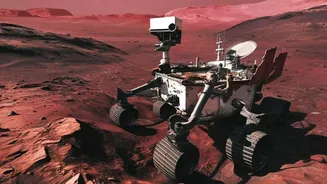
A New Brain for Lunar Science
The new tool is called the NASA-IBM Lunar Foundation Model. Think of it as a super-intelligent brain pre-trained to understand the Moon's surface. Unlike traditional AI that needs to be built from scratch for each specific task, a 'foundation model' is pre-loaded
with a vast amount of general knowledge. In this case, it was fed petabytes of data collected over decades, primarily from NASA's Lunar Reconnaissance Orbiter (LRO), which has been meticulously mapping our celestial neighbour for over 17 years. By training on this massive dataset, the AI learns to identify geological features and patterns far faster than any human researcher could. The collaboration combines NASA's immense archive of scientific data with IBM's formidable AI expertise, building on the company's watsonx.ai platform.
Why 'Open-Source' Is a Game Changer
Perhaps the most significant aspect of this launch is that the model is open-source. NASA and IBM have made it publicly available on Hugging Face, a popular collaborative platform for the AI community. This means that any scientist, researcher, or student anywhere in the world can access and use this cutting-edge tool for free. This approach democratizes space science, moving away from siloed, proprietary tools. By sharing the model, the agencies are inviting global collaboration, allowing others to build upon their work, adapt the model for new scientific questions, and accelerate the pace of discovery collectively. It continues a long tradition at NASA of making its vast scientific data archives accessible to the public for the benefit of all.
Paving the Way for Artemis
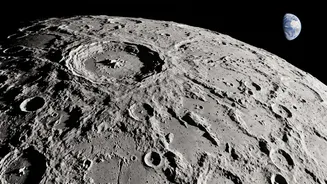
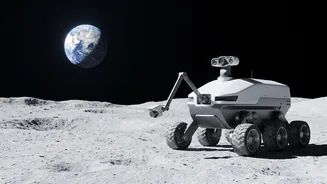
This AI is not just an academic exercise; it has a direct application for NASA's Artemis program, which aims to establish a sustainable human presence on the Moon. One of the model's primary jobs is to rapidly create better maps, identifying crucial features with unprecedented speed and accuracy. This includes charting previously uncatalogued craters, which provides insight into the Moon's history. More critically, the AI is being used to find the best potential locations for water ice, especially in the permanently shadowed regions near the lunar poles. Finding accessible water is considered the holy grail for a lunar base, as it can be converted into drinking water, breathable oxygen, and even rocket fuel for future missions to Mars. The model will help pinpoint the most promising areas for future robotic and human exploration.
Unlocking the Moon's Geological Past
Beyond planning for the future, the AI model is also helping scientists understand the Moon's distant past. It can quickly identify rare and unusual geological features, such as 'irregular mare patches'. These are thought to be signs of relatively recent volcanic activity, and their presence challenges existing timelines for how the Moon cooled down over billions of years. By mapping these features more efficiently, scientists can piece together a more accurate understanding of the Moon’s thermal evolution. The AI acts as a tireless assistant, scanning enormous mosaics of images to find these geological needles in a cosmic haystack, a task that would otherwise take researchers countless hours.
Part of a Bigger Picture
The Lunar Foundation Model is the latest product of a fruitful and ongoing partnership between NASA and IBM. It joins a growing family of AI models designed to tackle big scientific challenges. This collection already includes the 'Prithvi' models, which are trained on Earth observation data to help monitor climate change, map floods, and predict crop yields. Another model, named 'Surya', is a heliophysics AI focused on understanding the Sun's activity and forecasting space weather that can impact technology on Earth and in orbit. This broader strategy demonstrates a clear vision: instead of building a new AI for every problem, researchers can use these powerful, open foundation models as a starting point, adapting them to accelerate discovery across multiple scientific domains.