




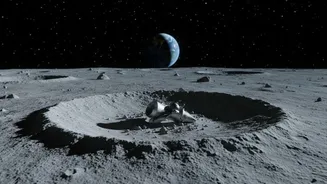
A Prize from the Dark Side
In June 2024, the world watched as China’s Chang'e-6 lander touched down in the South Pole-Aitken (SPA) Basin, the largest and oldest impact crater on the Moon. For decades, scientists have theorized about this region, but all previous lunar samples,
from both American Apollo and Soviet Luna missions, came from the near side. This left a huge gap in our knowledge. Chang'e-6 drilled and scooped up nearly two kilograms of precious soil and rock, a historic haul that promised to answer long-standing questions about why the Moon's two faces are so dramatically different. Upon their return to Earth, these samples were distributed to research teams, with one group focusing on 28 tiny fragments of impact melt—rocks forged in the intense heat of an asteroid strike.
The Cosmic Timekeepers
To unlock the secrets of these fragments, scientists needed to know their age. This is where a clever technique called Argon-Argon dating comes in. Think of it as a natural, radioactive clock embedded within the rocks themselves. The method relies on the slow, predictable decay of a specific type of potassium (potassium-40) into argon-40, a stable gas. When a rock is molten, like after an asteroid impact, any argon gas can escape. But once it cools and solidifies, the newly formed argon gets trapped inside the rock's crystal structure. By measuring the precise ratio of potassium-40 to the trapped argon-40, scientists can calculate exactly when the rock cooled and its 'clock' started ticking. This provides a definitive age for the impact event that created it.
Challenging a Cataclysmic Theory
For years, the leading theory about the early solar system was the 'Late Heavy Bombardment'. Based on near-side Apollo samples, which mostly dated to around 3.9 billion years ago, scientists believed the inner solar system experienced a sudden, intense spike of asteroid impacts during that period. However, the Chang'e-6 far-side samples tell a different story. The argon dating of the 28 fragments revealed a wide range of ages, from 4.33 billion to just 1.13 billion years old. Crucially, there was no cluster of ages around 3.9 billion years ago. This suggests that instead of a brief, violent cataclysm, the Moon likely experienced a long, steady decline in impacts over billions of years. The Apollo samples, it now seems, may have been skewed by debris from one massive, near-side impact, not a solar system-wide event.
A New Timeline for the Moon
The analysis of these far-side rocks is redrawing the timeline of lunar history. One study precisely dated the Apollo Basin, where Chang'e-6 landed, to 4.16 billion years old. Other basalt fragments showed evidence of volcanic activity on the far side as recently as 2.8 billion years ago. This is a significant discovery, as it was thought that volcanism on the far side ceased much earlier than on the near side. The diverse ages and compositions of these fragments provide a cleaner, more complete record of the Moon’s evolution. They give us ground truth to verify theories previously based only on remote sensing, confirming that our crater-counting age models for the near side are also surprisingly accurate for the far side.