




A Pinwheel in the Primordial Haze
Imagine looking back in time, over 12 billion years, to a period when the universe was just 1.5 billion years old. Conventional wisdom held that you would see a cosmic construction site: small, clumpy, and irregular galaxies colliding and merging in a violent
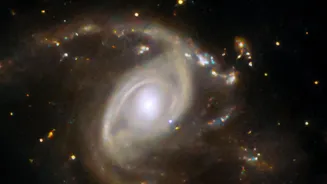
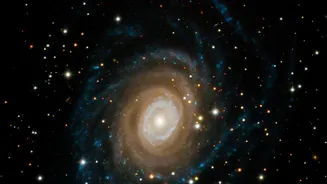
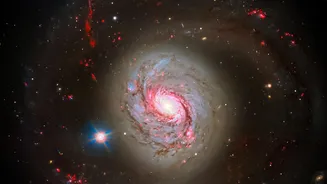
dance. What you would not expect to see is a beautifully structured, majestic spiral galaxy—yet that is exactly what astronomers have found. Using data from the James Webb Space Telescope (JWST), two Indian scientists, Rashi Jain and Yogesh Wadadekar, identified a galaxy with two perfectly formed, symmetrical spiral arms. This type of galaxy, known as a “grand-design spiral,” was believed to take billions of years to develop its elegant shape. Yet here one is, existing in an era previously thought too turbulent to support such order.
An Indian Name for a Cosmic Marvel
The researchers, from the National Centre for Radio Astrophysics (NCRA-TIFR) in Pune, named their discovery Alaknanda. The name holds deep cultural significance; Alaknanda is a Himalayan river that is one of the two headstreams of the Ganga. It is considered a sister river to the Mandakini, which is the Hindi name for our own galaxy, the Milky Way. The choice of name beautifully connects a groundbreaking cosmic discovery to Indian heritage, reflecting the pride of finding a celestial sibling to our galactic home in the distant past. The discovery itself was a feat of persistence, identified after poring over images of tens of thousands of distant objects captured by the powerful JWST.
Why Alaknanda Changes Everything
Prior to this, astronomers believed that the formation of a grand-design spiral was a slow and steady process. It required vast amounts of gas to cool and settle into a stable, rotating disk, a process thought to take many billions of years. The early universe was simply too hot and chaotic for such well-behaved structures to emerge. Alaknanda defies this timeline completely. It appears to have amassed a staggering 10 billion times the mass of our sun and organized itself into a stunning spiral disk in just a few hundred million years. That's an extraordinarily rapid assembly by cosmic standards. Furthermore, it is a hive of activity, forming new stars at a rate roughly 20 to 30 times faster than the Milky Way does today.
A Cosmic Lens and Sharper Eyes
Spotting Alaknanda in such detail was possible thanks to a fortuitous cosmic alignment. The galaxy is located behind a massive galaxy cluster known as Abell 2744. The immense gravity of this cluster acts as a natural magnifying glass, bending and amplifying the light from Alaknanda. This phenomenon, called gravitational lensing, made the distant galaxy appear twice as bright, allowing the James Webb Space Telescope to resolve its structure with unprecedented clarity. It's a testament to the power of both natural cosmic quirks and human ingenuity, demonstrating how the JWST's advanced infrared capabilities are pushing the boundaries of what we can observe.
Rewriting the Story of the Universe
Alaknanda is more than just a single, unusual galaxy; it's a key piece of evidence suggesting our models of galaxy formation are incomplete. It proves that the early universe was capable of creating complex, orderly structures far more quickly than previously imagined. This discovery compels astronomers to revisit their theories and explore new possibilities for how galaxies like our own came to be. Does this mean that planets, star systems, and perhaps even the conditions for life could have emerged earlier in the universe's history than we thought? Researchers now plan to conduct follow-up observations to study the motion of stars and gas within Alaknanda, hoping to unlock the secrets of how it formed so fast, so early.