







What Did Meta Announce?
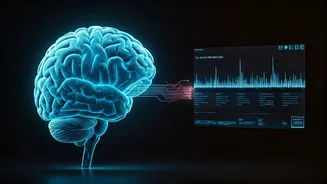
Meta recently unveiled Brain2Qwerty v2, an advanced AI system that can translate brain activity into coherent text. The most revolutionary aspect of this research is that it is non-invasive, meaning it does not require any surgical implants. This sets
it apart from other well-known brain-computer interface (BCI) projects, like Elon Musk's Neuralink, which rely on surgically embedded electrodes. Meta’s approach represents a major leap forward, with the company stating the research could one day help millions of people with neurological conditions that prevent them from communicating. The system has shown remarkable progress, achieving an average word accuracy of 61%, with the top-performing participant reaching 78%. This is a dramatic improvement over previous non-invasive methods, which hovered around 8% accuracy.
How Does It Actually Work?
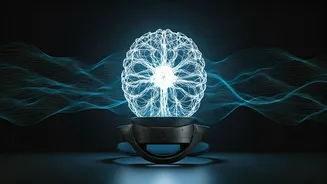
Instead of reading your mind in the abstract, the system decodes the brain signals associated with the intention to speak or type. The technology uses magnetoencephalography (MEG), a non-invasive scanning method that measures the faint magnetic fields generated by your brain's neurons. Subjects in the study wore a helmet-like MEG device while typing out sentences. The AI was trained on thousands of these sentences and their corresponding brain activity patterns. The system uses a multi-layered AI approach. First, deep learning models process the raw, noisy brain signals. Then, a large language model (LLM), similar to the technology behind chatbots, helps organize the decoded information into coherent words and sentences, using context to correct errors.
A Potential Lifeline for Patients
The primary and most immediate application for this technology is medical. For individuals who have lost the ability to speak due to conditions like brain lesions, amyotrophic lateral sclerosis (ALS), or locked-in syndrome, a non-invasive BCI could be life-changing. It offers the hope of restoring communication without the risks and costs associated with complex brain surgery. By developing this technology in the open and sharing their code, Meta hopes to accelerate research across the neuroscience community, potentially leading to faster diagnosis and treatment of neurological disorders. If further development can close the accuracy gap with surgical methods, it could represent a transformative shift in patient care.
From Lab to Your Living Room?
While the results are promising, don't expect to be typing emails with your thoughts just yet. The technology faces significant practical hurdles. Currently, MEG scanners are massive, expensive machines that require a magnetically shielded room, making them impractical for home use. Although the accuracy has improved significantly, it is still not perfect and may not be reliable enough for everyday conversation. However, researchers are optimistic. The accuracy has been shown to improve as the AI is trained on more data, suggesting it can continue to get better. Furthermore, advancements are being made in developing smaller, more manageable MEG sensors, which could one day make the technology more accessible.
The Ultimate Privacy Frontier
The prospect of a machine that can interpret brain signals naturally raises profound ethical questions about mental privacy. While the current technology decodes intended speech rather than random thoughts, the line could blur as the systems become more advanced. Experts warn that without proper regulation, technologies that can access brain data pose a severe threat to personal freedom and autonomy. The concept of "neurorights"—new human rights to protect cognitive liberty and mental privacy—is emerging as a crucial area of discussion. As this technology evolves, creating strong ethical guidelines and safeguards will be just as important as refining the science itself, ensuring that the brain remains a private space.