




An Accidental Discovery
In the world of astronomy, you don’t always find what you’re looking for. Sometimes, you find something even better. This was the case for a team of researchers studying the famous Beta Pictoris system, located a mere 63 light-years from Earth. The team was originally
using the JWST’s powerful Near-Infrared Spectrograph (NIRSpec) to analyze the atmosphere of a known planet, Beta Pictoris b. They weren't looking for another world, but the telescope’s incredibly sensitive data revealed an unexpected chemical signal—a 'barcode' of light that didn’t belong to the planet they were studying. After careful analysis, they confirmed the signal was from an entirely new planet, now named Beta Pictoris d.
Finding a Planet in Another's Atmosphere
So how exactly do you find a planet by looking at another one? It’s a revolutionary technique that could transform the hunt for exoplanets. Traditionally, planets are found either by seeing the dimming of a star as a planet passes in front of it (the transit method) or by directly imaging the planet itself, which is incredibly difficult due to the overwhelming glare of its host star. Beta Pictoris d, however, was found through its atmospheric fingerprint. The JWST's instruments are so precise they can capture the spectrum of light filtering through a planet's atmosphere. In this case, the data from the known planet was being subtly altered by the gravitational pull and atmospheric traces of its unseen neighbour. This is the first time a directly imaged planet has been discovered primarily through spectroscopy, proving that we can now find hidden worlds by deciphering the chemical clues they leave behind in their system.
Meet the New Giant: Beta Pictoris d
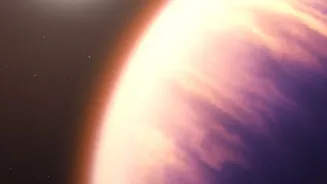
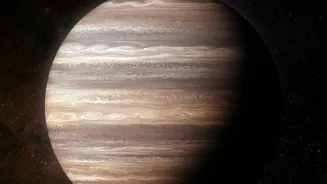
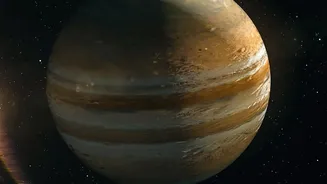
The newly found world is a gas giant, estimated to be at least twice the mass of Jupiter. It has a very wide orbit, taking a staggering 33,000 Earth years to circle its young, bright star. The Beta Pictoris system is only about 23 million years old—a cosmic toddler—making it a perfect laboratory for studying how planetary systems form and evolve. With the addition of this third planet, Beta Pictoris becomes one of only two known systems to have at least three directly imaged planets, offering astronomers a rare family portrait of a system in its youth. This discovery allows scientists to observe the complex gravitational dance between multiple giant planets and the dusty debris disk left over from their formation.
The Unrivaled Power of Webb
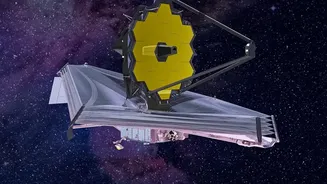
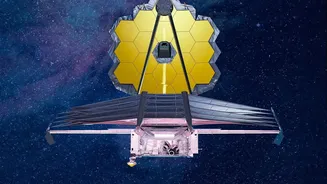
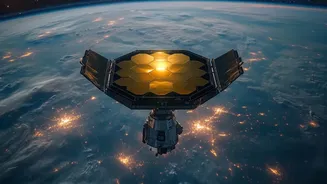
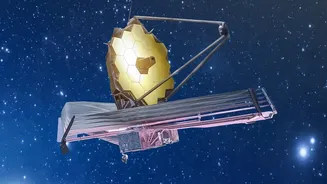
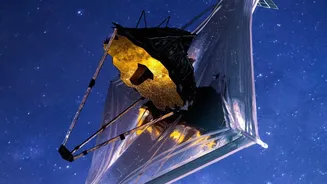
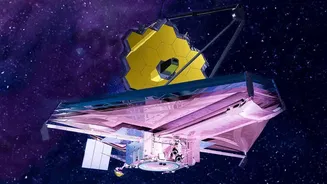
This breakthrough would have been impossible without the specific capabilities of the James Webb Space Telescope. Its ability to operate in the near-infrared spectrum and the precision of its NIRSpec instrument were crucial. While scientists had long theorized that planets could be found this way, it took Webb’s advanced technology to turn theory into reality. The telescope’s integral field unit, which records an image while simultaneously collecting a spectrum from every single pixel, allowed the team to not only spot an anomaly but to immediately analyze its chemical makeup, confirming it was a planet and not just a background star or an instrument glitch. This demonstrates a powerful new tool in the astronomical toolkit, one that can sift through complex environments and find planets that traditional methods might miss.
A New Era for Planet Hunting
The discovery of Beta Pictoris d is more than just adding another exoplanet to the catalogue, which now numbers in the thousands. It represents a paradigm shift in how we search for alien worlds. This spectroscopic method opens the door to finding planets in systems that are visually complex, such as those shrouded in bright, dusty disks where direct imaging is difficult. It means that every time scientists study the atmosphere of one planet, they could potentially be gathering data on others hiding nearby. As astronomers continue to refine this technique, the James Webb Space Telescope could unveil countless more hidden worlds, each with its own story to tell about the formation and diversity of planets across our galaxy.