









What is the 'Kyber' System?
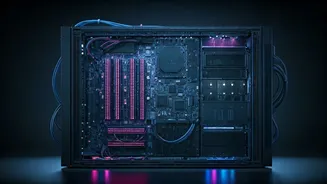
First, it's important to understand that Kyber is not just another graphics card or a single chip. It is a full-blown, rack-scale architecture—essentially a blueprint for an 'AI factory' in a single cabinet. Designed as the successor to the current Oberon
rack system, Kyber's goal is to house hundreds of next-generation GPUs and CPUs in an incredibly dense, liquid-cooled environment. The design features vertically stacked compute blades, a sophisticated internal midplane to reduce cabling, and a new 800-volt DC power infrastructure. It was engineered to support the forthcoming Rubin Ultra GPU platform, with configurations like the NVL576 aiming to pack a staggering 576 GPUs into one cohesive unit, operating as a single, colossal AI brain.
The Original 2027 Roadmap
For much of the past year, NVIDIA's public roadmap and industry reports have consistently pointed to a late 2027 launch for the Kyber system, timed with the release of its powerful Rubin Ultra GPUs. This aggressive timeline was part of the company’s new annual cadence, a strategic acceleration from its previous two-year cycle designed to cement its dominance in the AI sector. The plan was clear: after the Rubin platform's debut in 2026, the Rubin Ultra in the Kyber rack would follow in 2027, delivering an exponential jump in performance for training and running the world's most advanced AI models. This rapid succession was intended to leave little room for competitors to catch up.
An Unexpected Delay to 2028
However, recent reports emerging in early July 2026 have thrown a wrench in those plans. According to industry analysis, the Kyber rack architecture has been delayed by over a year, pushing its expected launch into 2028. The primary cause cited for this significant setback is not the silicon itself, but a more fundamental component: the system's incredibly complex printed circuit board (PCB). Manufacturing this massive, intricate board, which serves as the nervous system for the entire rack, has reportedly presented immense challenges, forcing NVIDIA to revise its schedule. This isn't a minor hiccup; it's a fundamental roadblock in building a machine of this scale and complexity.
The Ripple Effects of the Setback
The delay is having a cascading effect on NVIDIA's product strategy. Reports suggest that the Rubin Ultra GPU, the powerhouse chip meant for the Kyber system, has also been altered. The originally planned 'quad-chip' version has allegedly been canceled in favor of a more manufacturable 'dual-chip' design, which could effectively halve the performance of the flagship package. Furthermore, a backup plan to achieve similar scale by linking two current-generation racks together has also been reportedly scrapped due to cost and complexity concerns, leaving NVIDIA without a clear, near-term path to the massive scale-up Kyber promised.
Why This Matters for the AI Race
NVIDIA's delay is more than just an internal problem; it's a potential opening for its rivals. Competitors like AMD and Google, who are developing their own powerful AI accelerators, may now have a window of opportunity to gain ground in the high-stakes market for large-scale AI training clusters. More broadly, the situation highlights a crucial truth in the modern tech landscape: the frontier of AI is no longer just about designing faster chips. It's about system-level engineering, advanced packaging, power delivery, and cooling. The Kyber delay is a stark reminder that even for the market leader, the physical challenges of building the next generation of supercomputers are becoming as difficult to solve as the silicon design itself.